


Our scientific ecosystem is in a precarious position. We are balancing significant, intentional damage from the Trump administration alongside an increasing understanding that there was needed reform before January 20, 2025. Holding these two truths at once has proven difficult for institutions and individuals alike. Because institutions failed to enact reform efforts before Trump 2.0 when the scientific ecosystem was stronger, we now face reconstruction beginning from a defensive position. This is not ideal. However, this is a once in a lifetime opportunity to dream big and forge a brighter future for science and democracy.
Before Trump 2.0, trust between science and the public was strained. Bad actors seeking to dismantle independent centers of thought took advantage of weaknesses, and our systems proved to be vulnerable to these bad actors and anti-democratic forces. We now stand at a crossroads and we must determine how to move forward. We can rebuild a replica of what once stood or we can build something better. Our prior system was incredibly productive. It fit the reality of the world it was established in, but our scientific ecosystem was not designed to adapt flexibly to a changing world that has fractured under the pressure.
We have the chance to address systemic issues, to settle problems labeled “unfixable”, and forge a brighter, stronger future of science and democracy. Choosing the path of a stronger, more resilient future will require commitment and perseverance. With an eye towards successful reconstruction efforts, Stand Up for Science presents a way forward that prioritizes science as a public good, rectifies injustices, addresses systemic vulnerabilities to build resilience, and establishes a foundation for the scientific ecosystem that can be built upon for decades to come. We propose four distinct steps in this process. Each of these steps are explored in a dedicated chapter. The first - Assessment - is laid out in this chapter.
Assessment.
First, we must assess the damage to the scientific ecosystem, take inventory of the losses, and develop a deep understanding of how we arrived at this point. This process synthesizes data into a narrative of how we arrived at this point–including the key players, strategies and tactics used against us, vulnerable points in our systems, and accounting of the damage. Deep reflection is necessary to learn from our past mistakes and rebuild better.
Accountability.
Second, there is no democracy without accountability. When individuals, groups, and institutions harm the public through systems that are meant to serve, these parties must answer for the destruction they have caused and the breaking of the social contract. If the scientific ecosystem fails to embrace accountability as both a core value and an action moving forward, reconstruction efforts will be built upon distrust. Therefore, accountability cannot be overlooked as a critical part of the future of science and democracy.
Deconstruction.
Third and perhaps most challenging, systems that were built to exclude, extract, and enrich a small few cannot remain if science is to be centered around the public good. This goes for current and past systems. Legitimate criticisms have been leveled at the scientific ecosystem, we should not ignore these. Further, part of resilience is understanding that there will be more imperfect people and bad actors who seek to leverage science against the public. We must do the work now to ensure our systems cannot be weaponized again.
Reconstruction.
Fourth, we rebuild. Once the foundation is firmly established and the plans are laid, we have the privilege of enacting big changes. We must not lean back on the tendency to enact incremental modifications of the status quo. We must build the future we want to see, for generations to come.
Thus, through the process of white hot flame and hammer strikes meeting metal, we will forge the future of science and democracy.

“The great challenge confronting a conservative President is the existential need for aggressive use of the vast powers of the executive branch to return power—including power currently held by the executive branch—to the American people. Success in meeting that challenge will require a rare combination of boldness and self-denial: boldness to bend or break the bureaucracy to the presidential will and self-denial to use the bureaucratic machine to send power away from Washington and back to America’s families, faith communities, local governments, and states.”
-Russell Vought, Chapter 2, Mandate for Leadership:
The Conservative Promise (Project 2025), 44.
The assault on the federal research system did not begin with a vision for the science and research enterprise. It began with a theory of the presidency. So to understand the reshaping of the science and research ecosystem under Trump 2.0, we must first examine the motivations of a small connected group of political actors driving the President’s agenda, what unites them, and what drives them. At its center is a theory of power laid out in the Heritage Foundation’s Mandate for Leadership—the volume better known as Project 2025. While the codifying of vision was driven by the Heritage Foundation and its authors, the network and cast of characters that have been involved in executing this vision and funding it are much broader than just one organization. This chapter dwells on motive because the usual assumption no longer holds: that we are dealing with ordinary politics, and that the people driving it are acting in good faith. What follows is a sobering account of the perverse incentives that allowed these actors to emerge and to treat science as something to be captured to advance political goals.
Saying that Project 2025 contained a coherent plan for the science and research enterprise would be imprecise. Coordinated by the Heritage Foundation as a presidential transition project, Project 2025 laid out hundreds of conservative policies intended to transform the mission and operations of White House offices and federal agencies, including independent regulatory bodies. The authors were explicit in their vision for a conservative government that would deliver on four promises: the family as the centerpiece of domestic policy, a dismantled administrative state, closed borders, and the right to enjoy the “blessings of liberty”1. Science was not a subject so much as a tool, valuable when it served the authors’ revision of an agency and expendable when it did not. Individual chapters are dedicated to the U.S. Department of Agriculture, Department of Energy, Department of Health and Human Services, and Environmental Protection Agency, with special attention to the National Institute of Standards and Technology, National Oceanic and Atmospheric Administration, and the U.S. Global Change Research Program. Agencies are largely described as incompetent, overregulated, and “woke,” with many of their functions proposed for outsourcing or transfer to the private sector. The most consequential chapter was written by Russell Vought, then president of the Center for Renewing America, as part of the volume’s opening section, “Taking the Reins of Government.” That chapter supplied the theory of executive control—using the White House, and Office of Management and Budget in particular, to direct the agencies. Without it, much of what has since transpired across the federal research system would have been far harder to carry out.
With the blueprint in place, what followed were the actors required to enable the plan and the staff required to execute it. Agenda-setting for science and technology wasn’t a simple hand-off but a product of political bargaining that ultimately carved off a decisive part of the federal science and research enterprise to the tech-right: a tight-knit group of Silicon Valley billionaires and their operatives that spent years at odds with Trump. The current state of campaign finance and Trump’s readiness to sell a seat at the table for the right prices made the reconciliation between the tech-right and the President possible. Elon Musk, the largest donor of the 2024 cycle, was granted special access to the government and with him brought in the Department of Government Efficiency, which gutted the U.S. Agency for International Development and became a blunt instrument for canceling billions in federal grants. Some of the other actors, like Peter Thiel, stayed behind the scenes, but were nevertheless successful in installing their operatives as political appointees in the Executive Office of the President. Still, OMB via Russell Vought holds unprecedented sway on the staffing and the direction of federal funding in scientific agencies.
The conservative project supplied the theory of executive power. The tech-right supplied capital, staff, and a taste for blind deregulation. What the public and the scientific community are now seeing is a new arrangement in how federal science and research funding is organized and controlled, in which the tech-right dictates where to aim capital and the conservative operatives are the moral gatekeepers. Understanding the political and financial bargaining that has led us to this moment will help the scientific community understand the limits of traditional advocacy and bipartisanship that have been tried and true for decades but are no longer effective in advancing positive change, let alone in defending the scientific enterprise.
Christian Nationalism, Techno Fascism, and Unfettered Executive Power
The MAGA political base, conservative think tanks, and the tech-right converge around a shared interest in expanding executive power, stripping the administrative state, and dismantling regulations to ultimately transform government to fit their own designs. That overlap has produced an unlikely partnership of interest groups that share the same enemy in the concept of democracy but diverge greatly in their motivations and their desired end state.
A very visible bloc of partners in the conception of Project 2025 were Christian-right organizations that heavily shaped the document by promoting Western Christian ideas of family, sex, education, and religious liberty. Though not explicitly naming their worldview, the whole document is oriented around a Christian moral order that its authors treat as under attack by leftists who, by their account, have captured the government bureaucracy. Project 2025 turns this moral imperative into an executive agenda: restore biblically-based gender norms, treat diversity, equity, and inclusion initiatives as a warrant for firings and grant terminations, and protect Christian schools and churches from the administrative state.
Russell Vought, director of the Office of Management and Budget and a principal architect of Project 2025, sits at the center of the effort to dismantle what conservatives call the deep state. He has embraced the label Christian nationalist as a description of his worldview and calls himself a “radical constitutionalist.”2 In his account, too much power has migrated to Congress, the courts, and the career bureaucracy. The presidency, he argues, was meant to hold the whole executive power, not to manage a semi-independent administrative state. That is the operational core of his Project 2025 chapter on “Taking the Reins of Government”. Vought views independent agencies, insulated civil servants, and appropriated spending that a president opposes as constitutional errors to be reversed, including by refusing to spend money Congress has enacted. He frames this as a return to the Constitution’s original design after two centuries of drift. Since early 2025, we have seen how this theory of power has been executed with little to no regard to law and statutes.
Christian nationalist views are reflected throughout Project 2025, and the authors do not hide their intention to restructure government around a religious moral order. In some chapters they are explicit. The Department of Health and Human Services chapter was written by Roger Severino, who directed HHS’s Office for Civil Rights in the first Trump administration. Severino, a lawyer by training, drove civil rights rollbacks on sex, gender and abortion, and created the Conscience and Religious Freedom Division within HHS in 20183. In this chapter, Severino writes:
“Protect faith-based grant recipients from religious liberty violations and maintain a biblically based, social science–reinforced definition of marriage and family. Social science reports that assess the objective outcomes for children raised in homes aside from a heterosexual, intact marriage are clear: All other family forms involve higher levels of instability (the average length of same-sex marriages is half that of heterosexual marriages); financial stress or poverty; and poor behavioral, psychological, or educational outcomes.”
Severino argues that federal health and welfare policy should be rooted in biblical teaching and in a selective reading of social science that supports a particular view of gender and sexuality. Read in its entirety, Project 2025 is a rejection of secularism and of the separation of church and state that has been the foundation of religious freedom in the United States. It is not surprising that Project 2025 contains no serious discussion of the science enterprise. A research system organized around open inquiry and scientific evidence would be antithetical to the vision the project seeks to impose.
For the tech-right, the motivation is a different idolatry altogether: unencumbered technology and profit. Where the Heritage Foundation authored a vision of governance rooted in a desire for a Christian state, tech oligarchs became the willing suppliers of funding and personnel. Over the past several years, Silicon Valley billionaires who once disdained Trump have rallied behind him. Trump has taken money in politics to a new level of corruption by creating a pay-to-play system, where a Super PAC donation or a contribution to his ballroom can buy a cabinet position or a government contract. Watchdog reporting in 2026 found that more than half of known corporate donors to the White House ballroom project received new or expanded federal contracts totaling more than $50 billion in six months, including firms such as Palantir, Microsoft, Amazon, and Google.4,5
This alignment of ultra-wealthy entrepreneurs with Trump’s authoritarian government is what Gil Durán calls “tech fascism.”6 Silicon Valley discovered in Trump a way to seize power rather than evade it. Tech fascism, as Durán explains, offers AI, crypto, defense tech, and surveillance systems as tools the government can use toward authoritarian goals. In exchange for money and those tools, the tech oligarchs gain unfettered access to data, the power to surveil, more opportunity to profit, and a seat at the table to influence policymaking. Under Trump 2.0 the worldview of the technofascists finds an unexpected bedfellow in Christian nationalists and together they have effectively tapped the fear and insecurities of Trump’s MAGA base to ensure that the culture war continues to be their focus.
What we now see, nearly two years into a second Trump term, is a more coherent and aggressively law-defying strategy to turn the highest public offices into instruments of corruption and profiteering for a small circle of elites. The number of ultra-wealthy people holding power in this administration is unprecedented, and it is the most extreme expression yet of money in politics. Public Citizen found that the administration has appointed at least 57 people with assets of “as much as” $100 million to run federal agencies or serve as U.S. ambassadors – eight of them are billionaires now in public office.7
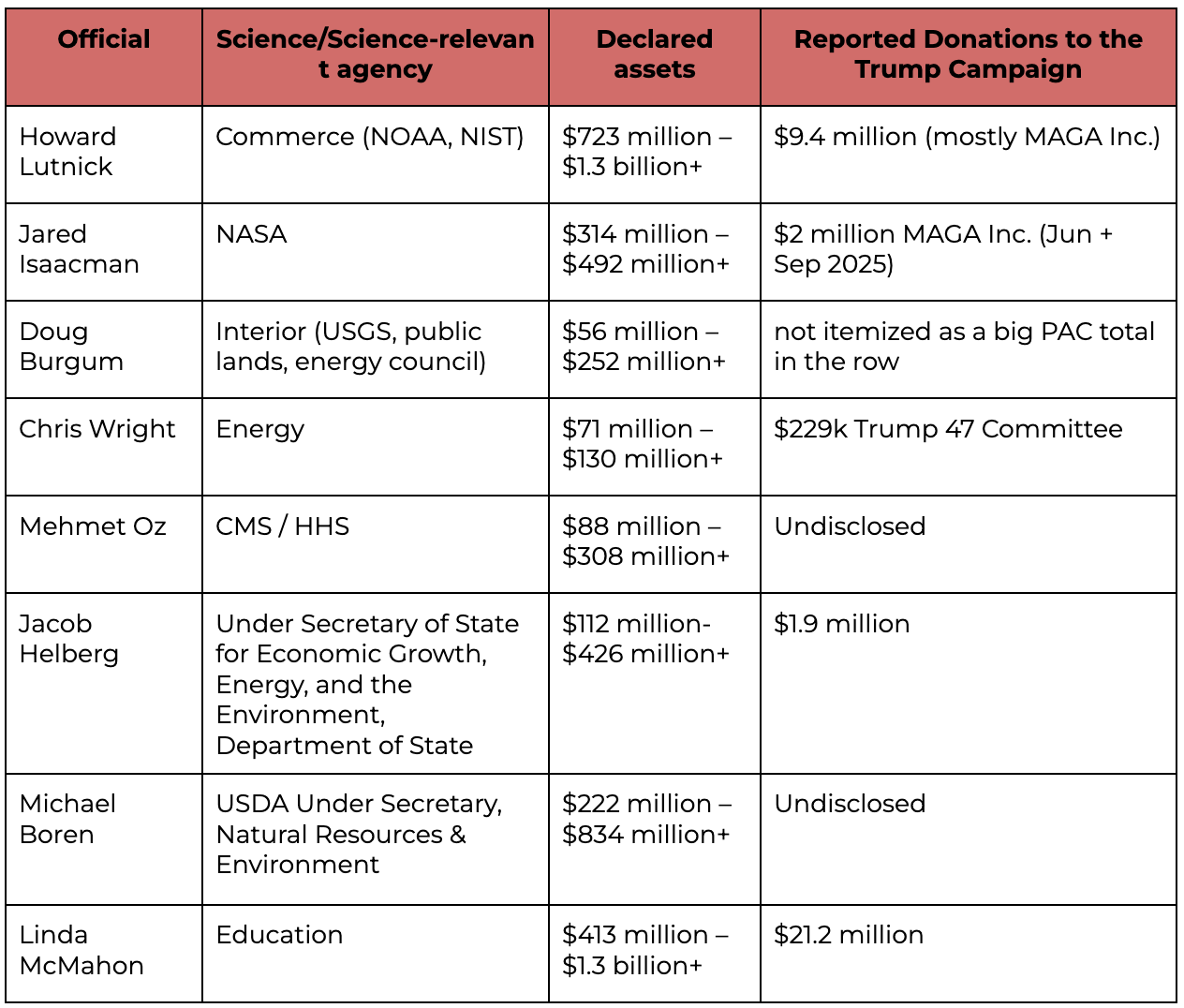
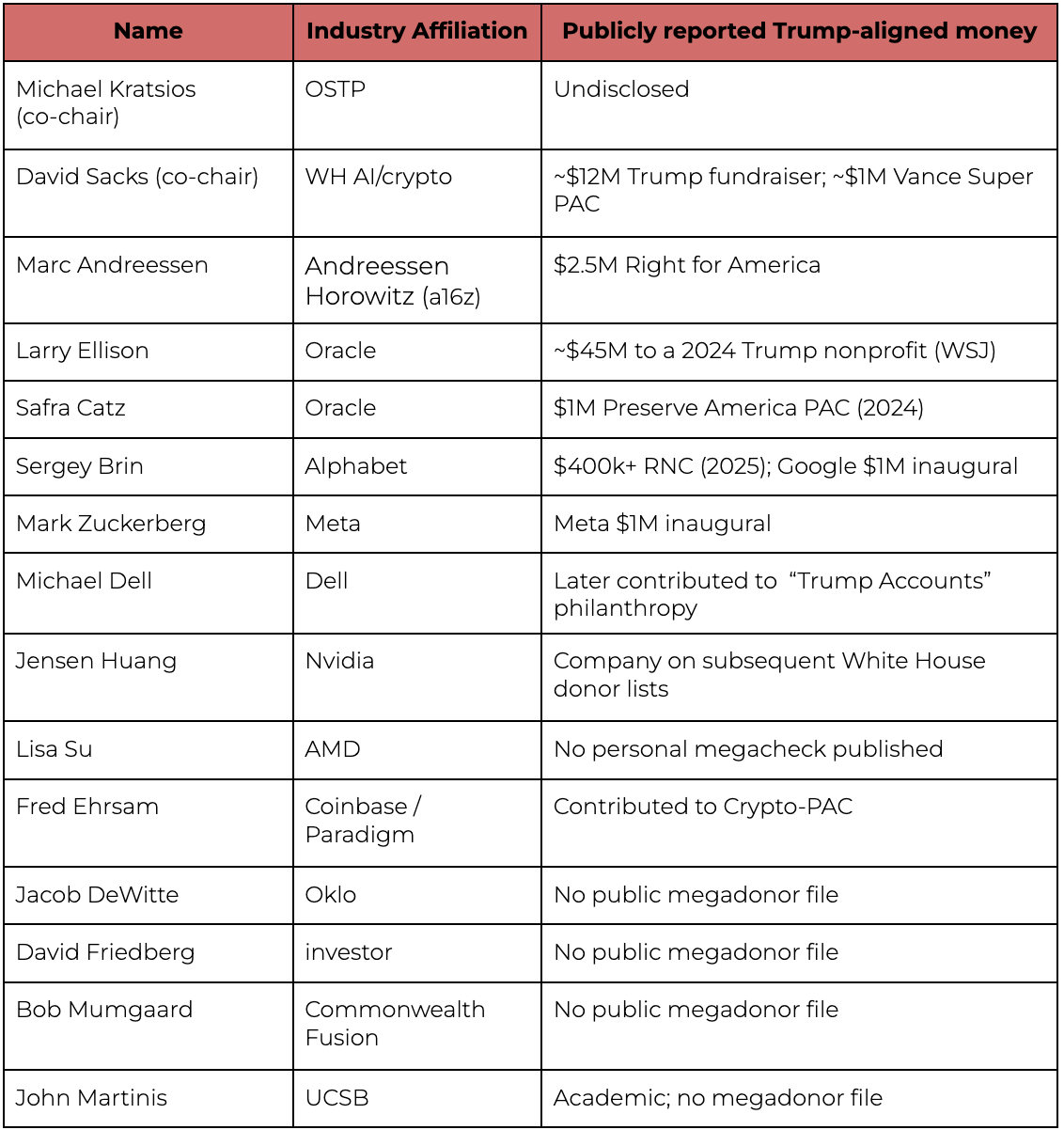
It is no secret that influence can be bought in Washington and that political appointments are often a result of political bargaining. What is distinctive in Trump 2.0 is scale and concentration: a cluster of extremely wealthy appointees now sit atop agencies that set research priorities, grant rules, and technical standards. Access to senior science positions can be purchased with generous donations, proof of loyalty, or proximity to tech oligarchs. Public Citizen reported that Jared Isaacman, now administrator of NASA, directed roughly $2 million to Trump-aligned political vehicles around the period of his nomination. Some appointments, like Robert F. Kennedy, Jr's, follow a more traditional route of political bargaining. He exited the 2024 presidential race, endorsed Trump, and delivered a vaccine-skeptical donor network and the Make America Healthy Again constituency and was subsequently appointed secretary of HHS. Other science-relevant appointments drew on the same donor milieu associated with the so-called tech-right. The table below summarizes publicly reported assets and Trump-aligned contributions for a cross-section of those officials. It illustrates how contemporary campaign-finance arrangements have enabled the ultra wealthy to hold formal authority over the public scientific enterprise.
Table 1. List of Agency Heads and their Reported Assets and Contributions to Trump Campaigns
Nowhere is the tech-right more visible than on the President’s Council of Advisors on Science and Technology, the outside body that is mandated to advise the president on science and technology. Past councils mixed university researchers, national lab leaders, and industry experts. Previous administrations, such as the Obama-era PCAST, met about six times a year and ranged across biomedicine, climate, education, and computing. The Trump administration rechartered PCAST in January 2025 and named 13 members in March 2026. The task force is co-chaired by Office of Science and Technology Policy Director Michael Kratsios and AI/crypto adviser David Sacks. The sole academic is John Martinis, a UC Santa Barbara quantum physicist and Nobel laureate who also works with Google. The rest are big tech’s biggest names: Oracle’s Larry Ellison and Safra Catz, Nvidia’s Jensen Huang, AMD’s Lisa Su, Meta’s Mark Zuckerberg, Google co-founder Sergey Brin, Dell’s Michael Dell, Andreessen Horowitz’s Marc Andreessen, Coinbase co-founder Fred Ehrsam, two nuclear CEOs (Oklo and Commonwealth Fusion), and investor and podcaster David Friedberg. So far the council has met only once, and as an advisory body it looks largely symbolic. But the access these pay-to-play seats on the Council provide is significant. As the Revolving Door Project reports, a place on PCAST gives these executives a sanctioned channel into the White House and, at times, direct access to cabinet members—the kind of access other companies pay lobbyists to chase.
The administrative state is being bent toward a conservative moral order and a tech-right vision of unregulated innovation. Ideas that threaten “traditional values” on sex, gender, reproduction, and climate are treated as illegitimate. At the same time, the tech right is pulling what remains of civilian federal science money toward AI and adjacent technology. In the imperfect status quo, the scientific community still had meaningful leverage to inform the science and research agenda. This is no longer the case.
Table 2. PCAST membership and Trump-aligned donations
Permissionless Innovation and the Fetishization of Industrial Policy
Innovation has become somewhat of a catch-all term and a topic favored by Washington DC policy circles and techno-optimist organizations who see it as a uniting force that cuts through political polarization and a non-partisan topic that can hold a big tent coalition together. The obsession with innovation and industrial policy as an organizing principle rests on a set of assumptions: that technological innovation leads to economic prosperity, that it can solve the world’s biggest problems, and that industry and entrepreneurs are acting in good faith and in the public’s interest. It was no surprise then that Michael Kratsios’ confirmation as OSTP Director was broadly supported in the scientific community—from investors and technologists in the “little tech” ecosystem8 to university associations such as Association of Public and Land-grant Universities,9 which believed he would champion a holistic science agenda and be sympathetic to the scientific community. Their enthusiastic endorsement provided important legitimacy to the tech-right vision and helped create the enabling conditions for unelected political appointees to redirect enormous public capital toward a narrow set of interests.
Two years into Trump 2.0, the tech-right has succeeded in capturing a significant portion of the U.S. scientific enterprise and has increasingly gained more access to critical government functions. Their aim is to commandeer the scientific enterprise—and the tax payer dollars that fund it—at the technologies it favors, and, where useful, to deregulate so that technological and industrial development can run unencumbered. That vision is laid out clearly in OSTP’s July 2026 report, Science: A New Golden Age, which argues for “permissionless innovation” and recycles a set of ideas fashionable among techno-optimist think tanks in Washington. Much of their ideas for government reform is rooted in the assumption that innovation bottlenecks are best solved by steering public money toward projects that are organized like venture-backed startups. The import of Silicon Valley’s fetishization of technology and venture capital culture is no accident.
Kratsios’ role in establishing the federal science agenda matters not only as OSTP Director but because of his prior positions as Peter Thiel’s chief of staff and Scale AI’s managing director for strategy. Though not himself trained in the sciences, he has built a career in Thiel’s orbit and in the tech-industrial space that makes him uniquely qualified at orchestrating a government-wide AI initiative. As we have seen over the past nearly two years and through the vision articulated in the New Golden Age report, Kratsios is far from a neutral actor.
Tech investors and industry have always had a vested interest in federal funding and regulations but what sets this administration apart is that they are no longer an external influencer but a principal driver in governing and agenda setting. What we now see is a result of this fetishization of innovation that claims perpetual competition against China, making endless technological innovation existential. As billionaire Marc Andreesen, who sits on PCAST and has funded Trump’s campaigns, articulates in his Techno-Optimist Manifesto10: “We believe that there is no material problem—whether created by nature or by technology—that cannot be solved with more technology.”
Capturing Public Funds for Private Interest
The shaping of the federal science agenda has never been apolitical. For decades an imperfect division of roles—Congress, the White House, outside constituencies—still produced priorities that had to answer, however unevenly, to public need. The status quo was always in need of reforming but what the current administration has effectively achieved is the undoing of the federal administrative state to enable corporate capture and profiteering. The U.S. federal science agenda is now being organized by a small group of people beholden not to the public but to private corporate interests. In this arrangement, the scientific community retains little independent political leverage except insofar as it adopts the prevailing vocabulary of innovation, geopolitical competition, and technological solutionism.
Understanding the motivations and actors driving our current political systems is an essential step in navigating this new political terrain and to better develop the tools and strategies to defend science and democracy from further descent into authoritarianism. We have watched scientific integrity come apart in real time—grants terminated, expertise sidelined, public-need research defunded. We have also seen what happens when the community acts together in response. The recent pause on the OMB proposed rule is one example: individuals and organizations came together to keep an imperfect system from further capture. It was one of the scientific community’s clearest rejections of authoritarian control, even if many organizations never used that word. They were clear about the principle that mattered: putting funding decisions in the hands of political appointees is incompatible with scientific integrity.
As the scientific community rallies around issue after issue, we cannot mistake the forest for the trees. The goal is not only to win the next fight. It is to name and stop unchecked presidential power, the corruption of science, and the delegitimization of scientific expertise. The project to remake the U.S. science and research enterprise in the name of corporate interest is well underway. It can still be stopped and we all have a direct stake in the outcome.

Federal scientific infrastructure was designed deliberately to distribute authority across career scientists, expert committees, peer review panels, agency leadership, Congress, and independent boards. These distinct but interacting components serve a key purpose: to limit the influence of any single decision-maker while putting scientific judgments through multiple layers of evaluation.11 These elements are therefore safeguards intended to shield our American scientific enterprise against political ideology dictating scientific conclusions.
Despite these tenets of our scientific infrastructure, the Trump administration has made no secret of its ambition to restructure the infrastructure to put these previously independent bodies directly under the control of the executive branch, while simultaneously disrupting the infrastructure in ways that sow confusion, fragmentation, instability, and reduce the rigor of the process. In February 2025, the administration issued the Executive Order 14215 which called for presidential “supervision and control of the entire executive branch.”12 The next day, the administration issued the Executive Order 14219 which explicitly announced that it planned to “commence the deconstruction of the overbearing and burdensome administrative state.”13 Three months later, Executive Order 14303, “Restoring Gold Standard Science,” set out to establish federal-wide standards that align with the president’s political ideology.14 Since the release of these Executive Orders, the Trump administration has removed and restructured independent scientific review, hollowed out and disrupted institutional scientific capacity, and aggressively moved to expand executive power and centralized decision making.
In this section we summarize the strategy and actions taken by the second Trump administration thus far which have disrupted our scientific enterprise.
Hollowing Out and Disrupting Institutional Scientific Capacity
On day one of the second Trump presidency, the administration released Executive Order 14158, titled “Establishing and Implementing the President’s ‘Department of Government Efficiency,’” also known as DOGE. Soon after, on February 11, 2025, the Trump administration released Executive Order 14210, titled “Implementing The President’s “Department of Government Efficiency” Workforce Optimization Initiative,” which explicitly instructed federal agencies to identify components of the agency that could be targeted for elimination or consolidation.15 In an attempt to address these EOs, federal agencies implemented redistribution of responsibilities, relocations, and firings of employees.
In pursuit of these “workforce optimization” goals, agencies quickly began shedding employees. The U.S. Office of Personnel Management reported that by March 31, 2025—just over one month after EO 14210 was released—federal employment had already fallen by more than 23,000 employees, and that hundreds of thousands more departures were expected through deferred resignations and other mechanisms.16 Many agencies that pursue scientific research were substantially affected by this disruption. For example, in March 2025, HHS announced plans to cut 10,000 full time employees or nearly one-fourth of its workforce.17 The hollowing out of the federal workforce continued over the next months and by July 2025, other agencies including EPA announced workforce cuts totaling close to one-fourth of its own full time employees after separations and reductions in force.18
EO 14210 also explicitly called for agencies to prioritize targeting offices performing functions “not mandated by statute or other law” for RIFs—this provided significant latitude for political appointees to slash offices that were not aligned with conservative goals. In response, EPA Administrator Lee Zeldin announced in May 2025 reorganization plans to move scientific expertise into a new Office of Applied Science and Environmental Solutions under the Office of the Administrator, putting oversight directly beneath Trump appointee Zeldin.19 In pursuit of this reorganization, the EPA eventually eliminated its Office of Research and Development in February 2026, sparking widespread concerns that this closure marked the end of independent research at the EPA.20
Dramatic restructurings happened across all federal agencies. In response to EO 14210, HHS announced plans in March 2025 to consolidate twenty-eight divisions into fifteen.20 Among these reconsolidation plans included a proposal to collapse the Office of the Assistant Secretary for Health, Health Resources and Services Administration, Substance Abuse and Mental Health Services Administration, Agency for Toxic Substances and Disease Registry, and National Institute for Occupational Safety and Health into a new, singular entity: the Administration for a Healthy America. Despite the distinct missions across these divisions, the new plan would instead reorganize around Trump appointee Kennedy’s Make America Healthy Again priorities.21 So far, this major restructuring of HHS has stalled in the courts and would still require congressional authorization. Even so, this has not stopped the administration from removing or reshuffling programs and functions.
These examples paint a consistent picture of federal agencies simultaneously gutting and reorganizing agency personnel and organizational structures as a part of the effort to centralize that which was previously dispersed across offices and institutional layers.
Removing and Restructuring Independent Scientific Review
Scientific bodies of oversight are a key mechanism in the U.S. scientific enterprise, providing counsel, oversight, and advisory roles to federal agencies. In removing or fundamentally altering these bodies, federal agencies may operate with limited independent oversight, skewing the distribution of power in favor of the executive branch and its appointees. The examples we share here are non-exhaustive but illustrative of how independent scientific review was restructured and in many cases simply removed.
In response to Executive Order 14217 in February of 202522 —shortly after Trump took office—NASA terminated the separate Astrophysics, Biological and Physical Sciences, Earth Science, and Heliophysics and Planetary Science Advisory committees. NASA then announced that the five science division committees would be merged into a single committee with representation across the Science Mission Directorate,23 replacing the specialized committees with a centralized body.24 The byproduct of this change is a reduction in scientific rigor, and an increased ease in leadership’s ability to manage—and potentially influence—the flow of scientific input.
In response to the same EO 14217, the United States Geological Survey terminated its Advisory Committee for Science Quality and Integrity.25 Previously, the group was responsible for “monitoring and enhancing the integrity, quality, and health of all USGS science…and development of strong practice, policy, and supporting programs.” Interior Secretary Doug Burgum claimed the elimination of this committee was based on the notion that it was “unnecessary” and had “fulfilled the purposes for which [it was] established,”26 despite the fact that the committee had only met one time before being terminated.
In March 2025, the EPA announced that it would reconstitute both its Science Advisory Board and the Clean Air Scientific Advisory Committee, subsequently opening nominations for these replacement memberships.27 In line with this announcement, a newly constituted CASAC was announced in March 2026,28 and a newly constituted Science Advisory Board was announced in April 2026.29 While soliciting new board members is not unusual, the EPA’s request for new members followed a dismissal of all sitting board members in January 2025, including members whose terms had not yet reached expiration, giving Trump’s administration the opportunity to reshape them entirely with its own handpicked appointees.30
The Department of Health and Human Services also faced a notable shakeup in June 2025. Secretary Robert F. Kennedy, Jr. removed all seventeen members of the CDC Advisory Committee on Immunization Practices at once,31 with replacements handpicked by Kennedy himself. ACIP guides vaccine policy, safety, efficacy, and clinical needs for the CDC. However, the slate of replacement ACIP members faced fierce public feedback for their lack of scientific expertise and anti-vaccine rhetoric.32
Finally, in April 2026, the Trump administration simultaneously dismissed all twenty-two sitting members of the National Science Board.33 Prior to their dismissal, the members of the NSB helped establish National Science Foundation policies and served as advisors to both Congress and the president on science and engineering policy.34 Per AP reporting, dismissed members of the NSB expressed deep concerns for the future of NSF, with one dismissed board member stating this change could “eviscerate investments in fundamental research and in training of the next generation of scientists and engineers for our nation.”35
The restructuring and removal of advisory bodies was an easy target and a quick win that served multiple purposes: fewer committees and a smaller-looking government consistent with Project 2025’s claim of administrative bloat. Clearing the advisory boards also allowed the administration to stack them with ideologically aligned individuals and special interest groups. Together these actions reduced the independence and capacity for rigorous scientific review, while simultaneously increasing executive control over these agencies’ structures and science. The cumulative effect is a scientific advisory system actively shifting away from independent review and towards the hands of political leadership.
Rule-based Expansion of Executive Power and Centralized Decision-Making
Institutional capacity and scientific integrity were the first casualties of the Trump administration’s quest to dismantle the government. In 2026, after the administration had already unlawfully terminated grants and withheld funds Congress appropriated, the Office of Management and Budget proposed a rule that would make that kind of interference legal and have staying power beyond the Trump presidency. On May 29, 2026, OMB proposed OMB-2026-0034,36 which would convert major portions of the government-wide grant framework from OMB guidance into an OMB regulation. Among the changes proposed, OMB-2026-004 includes language that grants be reviewed by senior appointees, specifying that these selected appointees should exercise independent judgment rather than routinely defer to recommendations from experts. Under this framework, peer review would become explicitly advisory rather than determinative. This led to sweeping, nationwide pushback, including both individual and organization-level comments left on the proposal.37 In a rare show of courage, the National Academies of Sciences, Engineering, and Medicine, for example, publicly objected that requiring political appointee review in grantmaking processes threatens the independent peer-review system that underlies U.S. scientific leadership.38 In addition, Stand Up for Science alone mobilized supporters to submit more than 26,000 individual comments opposing the OMB proposal.
Despite sweeping pushback, many federal agencies—such as NSF, the National Institutes of Health, and the Department of Education—have already begun operationalizing many portions of the OMB’s proposed rule, attempting to codify it themselves ahead of the rule being finalized. For example, the NIH has attempted to revoke grants that conflict with the Trump administration's priorities,39 NSF has proposed overhauling its grantmaking regulations,40 and the Department of Education recently proposed a rule that revises grant selection criteria and funding priorities.41
As of September 2, 2026, Congress has blocked the OMB proposal until December 11, 2026.42 While many opponents of the proposed rule have welcomed the pause, it is only temporary. Additionally, the proposal does not exist in isolation—rather, it is the most sweeping expression thus far of a broader administration effort to centralize political control. Executive Order 14332,43 released in August 2025, required federal agencies to establish a process through which senior appointees would review funding announcements and discretionary awards for consistency with advancing the President’s policy priorities wherever applicable. Agencies have begun to incorporate this government-wide directive into their own grantmaking frameworks individually. For example, in June 2026, NSF released a draft replacement of its Proposal and Award Policies and Procedures Guide that incorporates senior-appointee review into its funding decisions.44
Other examples—to be discussed later in this report—include the weakening of civil service protections through the restoration of Schedule F under the title “Schedule Policy/Career”45 and the placement of ideologically-aligned leaders across agencies including, but not limited to, the NIH, HHS, EPA, and CMS.46,47 These personnel changes are again pieces of a restructuring plan which together manifest as an expansion of executive power.

Knowledge is a threat to authoritarian regimes insofar as it is accessible, viewed as legitimate, and independent from political control.48 The American federal government has always played a role in shaping the nation’s scientific priorities—its involvement is not new.49 However, a problem emerges when political authority extends beyond determining what research should be prioritized and begins to dictate what the evidence should say and who is allowed to say it. In other words, while the government has never been fully removed from the scientific process, it is nevertheless a core tenet of publicly-funded scientific research that, while public officials may direct priorities, political ideology should not dictate findings, suppress or erase inconvenient results, or determine the credibility of science or scientists according to political usefulness.
This independence from political ideology creates a particular problem for non-democratic administrations seeking greater control over institutions and the outputs produced by them. Research can document harms a government might prefer to minimize, contradict a politician’s preferred explanations, undermine the empirical basis of a politically preferred policy, or produce evidence supporting policies political leaders oppose. The threat posed by independent science to these regimes, then, is not necessarily what science says in any particular instance—it is that political power does not completely control what science is capable of saying.
The previous section examined this process structurally: the deconstruction and weaponization of the administrative state in pursuit of greater centralized control over science. In the previous section, we outlined the removal and restructuring of independent scientific review, the hollowing out of institutional scientific capacity, and the expansion of executive authority over scientific decision-making. But control over the institutions that produce science is only one dimension of control over science itself. Political influence can also operate over the production, circulation, and legitimacy of scientific knowledge—shaping what information remains accessible, which findings are treated as credible, what questions scientists are able to pursue, and who is recognized as a legitimate scientific authority.
In pursuit of greater political control over scientific narratives, governments may therefore seek not only greater centralized control over the production and circulation of research and scientific knowledge. In doing so it must also delegitimize science and scientists themselves. Across historical cases of political interference with science, several recurring mechanisms emerge. Here, we organize these mechanisms into five major pillars of the delegitimization of expertise and the scientific method: (1) removing access to information, (2) attacking scientists, (3) manufacturing uncertainty about established knowledge, (4) controlling what questions can be asked, and (5) replacing experts with loyalists. For each pillar, we describe the mechanism through a historical example, then examine how a similar mechanism has manifested under the second Trump administration.
Removing Access to Information
In July 1957, the Soviet Union’s State Censorship Committee compiled a list of topics that were not to appear in public reporting. Among the censored topics were forest fires, industrial and military accidents, radioactive contamination, and information on child mortality. The Soviet government was well aware these were problems facing the nation—experts, politicians, and even the Soviet secret service accumulated knowledge about the harmful environmental and human consequences of industrialization and environmental degradation. The real issue was that much of this accumulated knowledge did not fit within the state’s preferred account of Soviet progress. Information about environmental disasters and other consequences of industrialization were therefore restricted from public view.50
However, evidence that contradicts a government’s preferred account poses little challenge if the public cannot see it and researchers cannot retrieve it. This constitutes our first pillar: removing access to information. In order for research to threaten political narratives, that research must be published, datasets must remain available, government reports accessible, and scientists, the public, and policymakers must all be able to retrieve the information. When politically undesirable knowledge becomes more difficult to access, the evidence itself does not require questioning—instead, alternative accounts to political narratives simply become less present in the information landscape, leaving more room for the government’s preferred account to dominate.
In the modern era of technology, this does not simply manifest as book burning. Political restrictions can instead shape what information is published both in print and online, where that information is allowed to be published, and how easily it can be retrieved. For example, research examining more than 5,000 academic publications from scholars based at U.S. and Chinese universities found that under pressures associated with academic control and self-censorship in China, some politically sensitive topics effectively “disappeared” over time while others “migrated” from Chinese- to English-language publication venues.51 Control over access can therefore change not only what the public sees, but where knowledge is produced and circulated in the first place.
Since the start of the second Trump administration, substantial amounts of scientific information have disappeared from or been altered across federal websites. Climate information provides one particularly clear example. In June 2025, the federal website for the U.S. Global Change Research Program went offline, taking with it the primary federal portal through which the public could access the National Climate Assessments.52 These congressionally mandated, peer-reviewed assessments synthesize research on how climate change affects the United States, and had previously been publicly available through federal websites. While the administration initially indicated that the reports would be transferred over to NASA, NASA rejected this and publicly announced in July 2025 that it would not host them .
The federal climate information infrastructure was further narrowed through changes to Climate.gov, a National Oceanic and Atmospheric Administration website.53 In 2025, the staff responsible for maintaining the website were terminated and the site stopped publishing new content altogether (ex-NOAA employees eventually came together to re-create the website in their personal time).54 Additional websites that have gone dark or otherwise been scrubbed under the second Trump administration include websites on topics including HIV, LGBTQ+ health and resources, vaccination guidance, civil rights information, gender-based violence resources and more.55
Removing access is one way to diminish the influence of inconvenient evidence without successfully refuting that evidence. That said, governments need not necessarily remove information entirely to curb its influence. The evidence can remain entirely accessible while its credibility is attacked through another route we turn to now: undermining the scientists who produce the evidence.
Attacking the Scientists
At the start of the twentieth century, a thriving community of geneticists existed in the Soviet Union. Among them was one Nikolai Vavilov, a prominent geneticist of the time, and a renowned plant scientist. Vavilov was passionate about traveling the world to collect diverse samples of plant seeds, and turned his work into an enormous collection of genetic plant material. By using Mendelian genetics56 and selective breeding, Vavilov was able to improve agriculture in the Soviet Union.57 In the 1930s, however, Soviet leadership began championing a competing geneticist with alternative ideas: Trofim Lysenko.58 Lysenko’s perspectives better mirrored the political ideology purported by the Soviet Union, rejecting the scientific consensus behind Mendelian genetics and the existence of genes in the first place, and arguing instead that plants could acquire characteristics from their environments and pass those on to future generations of plants.59 Thus, the pseudoscientific genetic ideology dubbed Lysenkoism60 was formed.
While this could have theoretically remained a scientific disagreement alone, it did not. Lysenko unsurprisingly found support for his ideas from Joseph Stalin himself, in addition to a larger body of Soviet political leadership. The dispute between Lysenkoism and Mendelian genetics increasingly moved beyond the bounds of scientific evidence, with Mendelian genetics recast as an ideologically corrupted science. The geneticists that supported Mendelian genetics were denounced as “reactionary,” their research as “bourgeois” and “anti-people.”61 Vavilov himself was arrested in 1940, dying in prison three years later, and other scientists who continued to defend Mendelian genetics were pushed out of their positions or otherwise prevented from working.
An important lesson is to be learned from Lysenkoism: if you discredit the scientist on grounds of moral failings, you do not necessarily have to wade into the waters of actually disproving the science. This constitutes our second pillar: discrediting the scientists.
Most members of the general public, and politicians themselves, are typically not independently capable of replicating scientific studies, critically evaluating the results with an expertise perspective, or meaningfully deducing from competing interpretations of scientific findings. However, by simply raising into question the morality of a scientist, the scientific findings and deductions that scientist is championing become considerably less trustworthy in the eyes of the public.62 In other words, the credibility of a scientist and the credibility of their work are not neatly separable entities within the public mind. If you are able to undermine one, you will undermine the other without having to wade into the actual science.
Anthony Fauci is one of the cleanest contemporary examples of how scientific opinions that interfere with policy preferences can become a personalized series of attacks in the United States. During the 2020 COVID-19 pandemic, Fauci quickly rose to prominence in the public eye for his role as the director of the National Institute of Allergy and Infectious Diseases,63 quickly becoming one of the most prominent—and infamous—scientific officials in the history of the country.
In January 2025, President Trump terminated the federal security protection Fauci had continued to receive after leaving government due to ongoing threats against him, reinvigorating streams of attack against him.64 Several months later, the White House replaced the federal government’s COVID-19 information website with a page presenting the administration’s account of the pandemic. Rather than simply presenting an alternative interpretation of particular policies or pieces of evidence, the site explicitly centered Fauci—alongside former President Joe Biden and the World Health Organization—as a target of criticism in its account of failures surrounding the pandemic response.65
Scientists are not immune from criticism, and findings should be challenged as a fundamental principle of the scientific process. However, by attacking the moral character of a figure like Fauci, Trump and similar-minded politicians can avoid wading into the overwhelming evidence that COVID-19 precautions and vaccines saved lives66—evidence which runs contrary to the policy preferences of the Trump administration.67
Once scientists have been thoroughly questioned, a given administration sets itself up nicely to argue in favor of replacing previous scientists with political ideologues—which we cover in the following section.
Replacing Experts with Loyalists
Replacing experts with loyalists is often the flip side of attacking the scientists. By pulling into question the legitimacy of past scientists using moral attacks, it becomes easier to provide an argument for their replacement—often one who is more ideologically-aligned with the politicians of the present. For example, by the 1930s, Lysenko (detailed in the previous section) ended up rising from relatively obscure beginnings to becoming one of the most powerful scientific figures in biology during Soviet Russia, because his ideas were deeply attractive to Soviet political leadership since they fit neatly into the broader ideological belief that nature, like society, can be rapidly transformed under the optimum conditions. His political support allowed him to accumulate increasingly powerful positions within Soviet science, eventually becoming the director of the Institute of Genetics of the Soviet Academy of Sciences (which is now, ironically, called the Vavilov Institute of General Genetics).68 At the infamous 1948 meeting of the Lenin All-Union Academy of Agricultural Sciences, Lysenko presented his views as the scientifically and ideologically correct theory of heredity, announcing the Communist Party approved of his report. Classical genetics was subsequently pushed out of Soviet research and education.69
Expertise is produced through rigorous training, accumulated knowledge, empirical scrutiny, and demonstrated competence within a certain field. Scientific authority should therefore be, at least in substantial part, epistemic: the people given the greatest influence over scientific questions should have relevant expertise, and should remain accountable to the standards of evidence within their particular discipline. The relevant question is therefore not whether a given scientist’s positions agree with scientific consensus, but rather, whether their authority is meaningfully derived from relevant expertise and the strength of evidence they put forth—or, alternatively, if their authority is merely a byproduct of their position proving sufficiently useful for those in power to appoint them.
When ideological compatibility begins to substitute for disciplinary expertise as a criterion for scientific authority, the consequences extend beyond which scientific positions are elevated. Expertise is also part of the process through which evidence is evaluated: determining which information is relevant, assessing the strength of competing findings, recognizing methodological limitations, and deciding what conclusions the available evidence can reasonably support. Replacing expertise with political compatibility therefore risks weakening not only which conclusions are treated as authoritative, but the rigor of the process used to arrive at those conclusions in the first place.
One of the most prominent examples of this process under the second Trump administration concerns the CDC Advisory Committee on Immunization Practices.70 On June 9, 2025, Trump-appointed Secretary of Health and Human Services Robert F. Kennedy Jr. removed all 17 sitting members of the committee at once.71 Two days later, Kennedy announced eight hand-picked replacements. Among these was Robert Malone, who had opposed the use of mRNA vaccine technology, alongside other appointees who questioned aspects of existing vaccine policy.72 STAT additionally reported that several appointees had little to no vaccine expertise,73 and a subsequent Science analysis found that the new members had significantly less vaccine-science expertise than the panel they replaced.74
The original ousted panelists additionally publicly warned that Kennedy’s overhaul erodes the credibility of vaccine policy and public trust in immunization decisions.75 Naturally, however, the HHS described the decision to completely revamp the panelists in exactly the opposite terms— the department said the overhaul was intended to eliminate conflicts of interest, restore public trust, and ensure that “unbiased science” guided vaccine recommendations. Interestingly, as a part of a broader overhaul, HHS now identifies the principles of “Gold Standard Science” as an organizing principle, including what it calls “constructive skepticism of findings and assumptions.”76 While skepticism is an inherent part of the scientific process, it can easily be weaponized to manufacture uncertainty on well-established scientific knowledge, which we turn to next.
Manufactured Uncertainty On Established Knowledge
In the 1950s, a rapidly growing body of scientific evidence was beginning to show irrefutable evidence that cigarette smoking was linked to lung cancer. This was an obvious incoming threat to the U.S. tobacco industry, with fears of incoming public health interventions against the use of cigarettes motivating the industry to pursue tactics to stifle public fears on smoking. To do so, the industry recruited a band of scientists who were willing to challenge the findings that linked cigarette smoking to disease, while simultaneously drawing attention to the limitations and range of unanswered questions that still remained after considering the existing evidence. In doing so, the tobacco industry did not have to prove that cigarettes were safe—an impossible task—but rather, they simply had to sow doubt and convince smokers that evidence showing cigarettes could cause cancer was not yet settled.77
It was surprisingly effective. The work by the U.S. tobacco industry to sow doubt helped preserve uncertainty around cigarette smokers, even after the scientific case was too strong to overlook. In 1966, a Public Health Service survey found that over 60% of smokers were still under the impression that the relationship between cigarettes and cancer was “not yet proved”, and shockingly, more than half reported that they would not fully be convinced that cigarette smoking was actually harmful until the tobacco industry itself admitted it.78 Notably, these opinions were recorded after the U.S. Surgeon General issued a landmark 1964 report formally declaring that cigarette smoking causes lung cancer and other serious diseases.79
The work by the U.S. tobacco industry demonstrates our fourth pillar: an established scientific conclusion does not need to be wholly disproven to lose its influence—it may be enough to convince the public that the science is still uncertain.
As long as the scientific method continues, manufacturing uncertainty about well-established findings will be a possible line of attack for bad actors. The nature of science is that it rarely speaks in absolutes—findings are derived from approximations with margins of error, and even robustly demonstrated findings are often framed as theories, not conclusive evidence of how the world operates. It is essential in the scientific process that scientists are capable of acknowledging what is not yet known, can identify possible limitations of their work, and be able to update theories when new information is discovered. However, the uncertainty that exists within the scientific enterprise can also be corruptedly magnified in a way to make seemingly well-established conclusions appear far less certain than they realistically are—a process Dr. David Michaels (an epidemiologist at George Washington University) calls “Manufactured uncertainty”.80
One particularly stark example of this line of attack during the second Trump administration is in regards to the 2009 Endangerment Finding.81 In 2009, the EPA found that six greenhouse gases in particular threatened public health, as well as the welfare of both current and future generations of Americans. This finding became the backbone of many federal regulations on greenhouse gas emissions. However, In March 2025, Trump-appointed EPA Administrator Lee Zeldin publicly announced that the EPA would be reconsidering the Endangerment Finding, drawing explicit attention to the “significant uncertainties” he claimed were present in the science behind the original finding. To address this, the EPA commissioned the Department of Energy to assess the supporting climate science. Lo and behold, the DOE challenged the scientific basis underlying the 2009 Endangerment Finding, a challenge which was then used to support the EPA eventually rescinding the 2009 finding in February 2026.82
The science did not change—if anything, subsequent climate research following the 2009 finding has documented increasingly clear harms to human health and welfare. Manufacturing uncertainty on established knowledge is about amplifying desired findings, while suppressing unwanted contradictory information—it is a game of optics, not pursuit of ultimate scientific truth. This is best displayed by none other than Trump saying in 2024—prior to the DOE’s investigation of the GHG findings—he would pursue regulatory rollbacks for his polluter donors at events hosted by major industry figures.83
Like the administration’s slogan of efficiency and eliminating “fraud, waste, and abuse,” they have also co-opted the language of accountability to inject uncertainty in science. In May 2025 the White House issued Executive Order 14303, “Restoring Gold Standard Science,” directing agencies to rewrite the rules that govern how scientific information is produced and used so they match the order’s nine tenets. The language—reproducibility, transparency, uncertainty, peer review—almost sounds reasonable until it is read in the context of the power that sits with political appointees, who can now certify what meets the standard and what can be dismissed as not rigorous enough. That is how the “gold standard science” has become a tool to delegitimize work the administration does not want. Prior to the release of EO 14303, the NIH rescinded its final Scientific Integrity Policy,84 which had only been finalized just under six months prior. It is then unsurprising that, following EO 14303, the NIH released an agency-wide plan to instead implement the nine tenets of “Gold Standard Science” across its institutes.85
Thus far, we have covered four major pillars. The first two are primarily aimed at past work (Removing Access to Information and Attacking the Scientists), while the second two largely concern present policy (Replacing Experts with Loyalists and Manufactured Uncertainty on Established Knowledge). For our fifth and final pillar, we turn to the future. Political control over science can extend well into the future, shaping which questions are permitted to ask, and as a result, determine who is allowed treatment, whose future we will protect, what public health concerns will be addressed, and what emerging problems we have the opportunity to understand before they become public crises.
Controlling What Questions Can Be Asked
In 2018, the Hungarian government—under Viktor Orbán—deleted gender-studies graduate programs from the list of possible degrees offered by their universities.86 Members of Orbán’s government had a broad objection to the field, arguing that gender studies represented an ideology more than a legitimate academic discipline. The government in doing so weaponized its control over university accreditation to shape what academic disciplines are viewed as legitimate. The impact of this is not a deletion of access to gender-related studies, but rather, a discontinuation of researchers who specialize in gender-studies entering the workforce. A government may not need to directly suppress inconvenient or unwanted scientific findings that may threaten its policy preferences if it can halt the question from being asked in the first place.
This constitutes our fifth and final pillar: controlling what questions can be asked. The most effective way to suppress an inconvenient scientific finding may be to prevent the evidence from being produced in the first place. Scientific knowledge depends on more than the freedom to publish: researchers need funding, institutional support, access to data, labs, trainees, and years in which to pursue a question. Governments that control many of these resources therefore possess the influence to determine which questions may be funded or which fields are institutionally recognized at all. Political power can shape not merely how science is communicated but what knowledge or lines of inquiry should be pursued.
The pattern in the United States under the second Trump administration bears similarity to Hungary. In early 2025, the National Institutes of Health terminated more than 2,000 grants in just five months, with a large swath of the affected research and projects involving health equity and sexual and gender minority populations.87 A separate study found 64 canceled previously NIH-funded research grants, with specific subfields included examining HIV, cardiovascular disease, cancer, and other life-or-death illnesses in transgender populations.88 Of particular importance here is the language used to justify the termination notices, with projects involving work including diversity, equity and inclusion, gender identity, vaccine hesitancy, and other subjects terminated for being “no longer aligned with agency priorities.”
Again, it is not abnormal for federal governments to set research priorities at large. The concern for scientific independence arises, however, when the acceptability of the question itself is contingent on its political compatibility, rather than its scientific merit. This will additionally impact what research grants are proposed for years to come, as scientists preparing for the next round of grant applications can see which studies are getting terminated, what terms are attracting scrutiny, and what areas will not be supported altogether. Over time, these decisions influence the future of scientific literature by way of what information is being collected today.

America’s scientific and technology ecosystem is enormous, with almost a trillion dollars ($993 billion) in annual expenditure on research and development, according to the National Science Board. The overwhelming majority of these expenditures are on development, which involves the translation of known information into new products and services (about $670 billion). Much of this expenditure is measured through tax credits, which incentivize businesses to try to maximize and reclassify expenses that could qualify as research and development.89 Likewise, federal research and development is heavily tilted toward development-related activities, with slightly over half of federal R&D expenditure classified as development ($98 billion in 2023 as opposed to $97 billion in research90). Comprehensive assessments typically lag by two to three years due to the difficulty collecting comprehensive data on all research funding and performing sectors, meaning that the most recent analysis of the entire U.S. scientific and technology ecosystem, in terms of topline budgets, is data timestamped to the Biden administration.
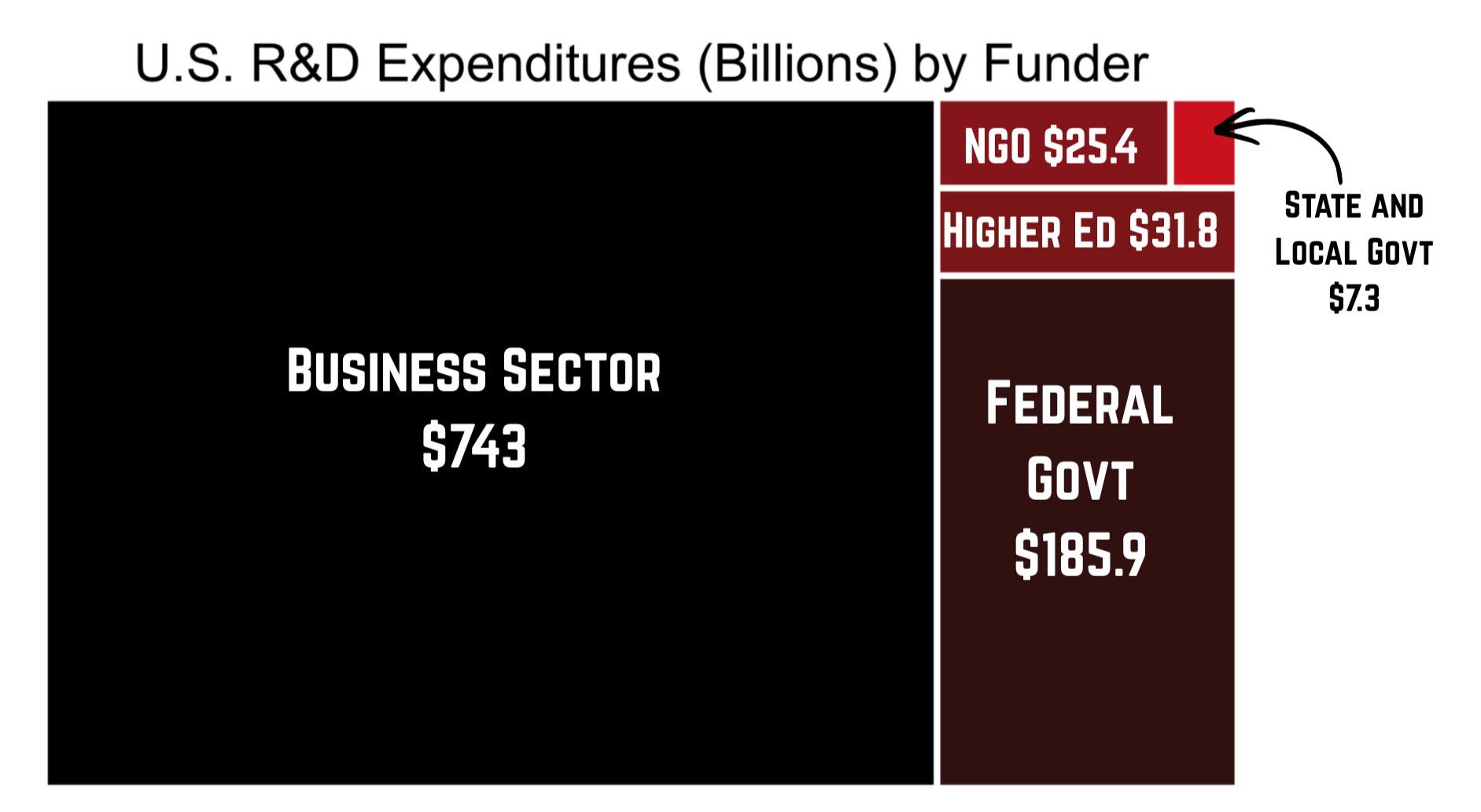
Source: National Science Board Science and Engineering Indicators, The State of U.S. Science and Engineering 2026, May 4, 2026.
As such, many of the most authoritative tools for measuring science and technology in the United States at the macro level are not yet at a point where they can be used to help tell the story of what’s happening in the United States currently. This is particularly true given the surge of funding allocated toward the Department of War in Fiscal Years 2025 and 2026, which surged research, development, testing, and evaluation spending for that single department to from about $140 billion to over $210 billion, with the (unlikely to pass) President’s budget request for FY2027 coming in at a staggering 350 billion.91 Even still, basic research activities within the DoW declined by 5.8 percent.92 Surge spending focused on 6.4 (advanced component development and prototypes), 6.5 (system development and demonstration), 6.7 (operational system development), as shown below.
These activities are difficult to characterize as “research,” but are absolutely necessary to understand the broader recharacterization of the science and technology ecosystem aggressively toward advanced platform development, with the primary financial beneficiaries being large defense contractors.
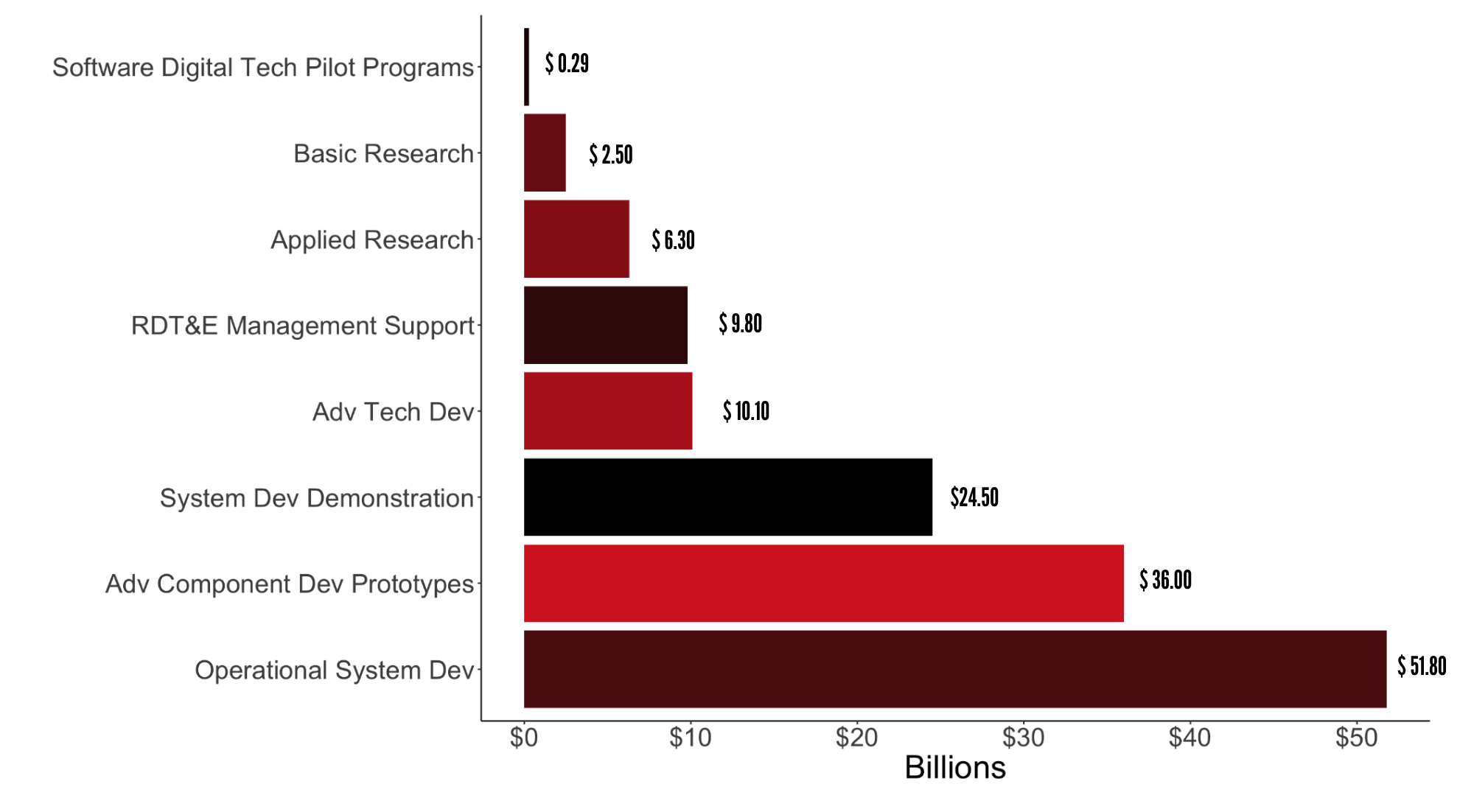
Department of War Research, Development, Testing, and Evaluation Funds by Character of Work, FY 2025 (In Billions)
Source: Congressional Research Service analysis of Under Secretary of Defense (Comptroller), Department of Defense Budget, Fiscal Year 2026, RDT&E Programs (R-1), June 2025.
A fair amount of work has been done within the community attempting to chronicle the economic impact of cuts by looking at changes in award patterns at the National Science Foundation and National Institutes of Health. Even if we exclude later-stage defense programs, grants to universities account for a relatively small amount of the overall research and development ecosystem and masks the importance of much smaller expenditures to the American economy. For instance, the National Weather Service, which produces products that influence global weather forecasts, has an operating budget of only about $1.5 billion dollars.93 According to the American Meteorological Society, every dollar invested in the NWS produces $73 dollars in value for the American public,94 while every dollar invested in the National Institutes of Health results in about $2.57.95 This does not make NWS investment more important or more effective than NIH, but reflects the vast difference in the products, utility, and the complicated nature of economic spillovers linked to science and technology-related activities. What it does do, however, is highlight the ways in which even seemingly minor damage done to intramural research programs (or even individual laboratories in the U.S. government) can have cascading and broad impacts that touch every aspect of American life. For instance, were the National Institute of Standards and Technology Radiation Physics Laboratory, which is currently under renovation, be forced to halt its operations, every medical device that uses radiation would need to be decertified within six months, having significant impacts on public health.96
As a result, it would be nearly impossible for any comprehensible report to provide a comprehensive overview of the changes in the U.S. R&D ecosystem, even using the largest big data tools or assisted by artificial intelligence, as the nature, character, and human impact of U.S. R&D investment is almost immeasurable. We are choosing to chronicle the ways in which the actions of this administration have already had significant impacts on the science and technology ecosystem and American life. This is best understood as a series of snapshots taken to help understand the transformation of the broader ecosystem.
Early Actions: Shock, Awe and Firings
On January 20, 2026, President Trump issued 26 executive orders on issues ranging from immigration to federal diversity policy to rules governing the federal workforce.97 The most significant of these was the establishment of the Department of Government Efficiency,98 transforming the U.S. Digital Service (created by President Obama in the wake of challenges with deploying government digital platforms after passage of the Affordable Care Act99). DOGE teams had already begun embedding themselves in government agencies as part of the transition process, gaining an understanding of the federal policy landscape. A chilling effect had already taken hold in agencies with the anticipated revival of Schedule P/C100 (which would transition many federal employees to “at will” status) and the announcement of various political appointees, many of whom had been involved in the development of Project 2025.
The other major executive order that had broad impacts on the scientific community was Executive Order 14151 “Ending Radical and Wasteful Government DEI Programs and Preferencing” (which would be used to justify the creation of “banned words” lists by federal agencies for the purpose of cancelling grants to universities). Less visible, but noticeable changes involved rapid moves to paralyze the administrative state, including the concentration of authority around hiring and budgets around the Office of Personnel Management and the Office of Management and Budget. Grant and contracting issuance authority was severely throttled across most agencies, with senior officials placing strict limits on procurement; for instance, all grants, cooperative agreements, and contracts exceeding $100,000 at the Department of Commerce were redirected to the Office of the Secretary for review. At places like the National Science Foundation and National Institutes of Health, notices of funding opportunities were routed through DOGE staffers before being passed to OMB and the Office of Science and Technology Policy.
Other significant actions included new restrictions on telework for the federal workforce, which caused immediate problems at agencies like the U.S. Patent and Trademark Office, whose workforce was overwhelmingly spread throughout the country and allowed to telework full time. Many federal facilities had adapted after COVID-19 and were not ready to take on a mass return to office. Employees who had been allowed to telework part time as the result of reasonable accommodations due to disability had their cases placed under review. The General Services Administration placed numerous government properties on lists of locations to shut down, including major labs and facilities like the Agricultural Research Service laboratories and the National Earth Satellite Data and Information Service buildings, through which data for all U.S. and international weather forecasts depend. While most of the actions targeting these facilities were reversed, the resulting chilling effect on agencies and the knowledge that these facilities would be targeted had immediate impacts on agency morale.
At the same time, the government began issuing mass termination notices on grants throughout the federal government, particularly those perceived to be connected with federal diversity initiatives or in conflict with the administration’s narrow set of priorities. While many of these were challenged in court, thousands of grants remained cancelled, with larger impacts to women researchers and minority groups, who also had larger shares of their awards still available.101
In February 2025, the government began mass terminations of government employees on probationary leave. While these employees were ostensibly those who had been with agencies for limited periods of time, many were either former contractors who had served in these agency offices for years or tenured federal employees returning to service after a break in employment. Employees hired through Schedule A with documented disabilities and those in certain specialized positions (fairly common in science agencies) often had two or three year probationary periods, placing them at greater risk of termination. While some agencies, like the National Science Foundation, ultimately rescinded the terminations as a result of court challenges, other groups still remain inactive today.
In the Office of Science and Technology Policy, initial waves of employees who were brought on to serve in the Trump administration were removed and dismissed without explanation. This also included officials in the National Security Council, which has traditionally been heavily involved in coordinating science and technology policy efforts and managing interagency coordination processes (in the current administration called policy coordination committees, in previous administrations interagency policy committees).
As 2025 progressed, agencies began implementing large-scale reductions in force and relocation efforts, particularly in places like the U.S. Department of Agriculture and technical offices within the U.S. Department of State. As was the case with probationary firings, many of these were done without the chance to exempt critical employees and even included the elimination of offices that ostensibly served administration priorities or were favored in Project 2025 (for instance, the Office of Intellectual Property Enforcement at the State Department, or the Office of Space Commerce at NOAA). Many of these employees served evidence-based policy functions, providing research relevant to agency operations. Among the more dramatic cuts was the Department of Education’s research and statistics division, whose staff was cut from about 100 to three.102 Many of these agencies then integrated DOGE staffers as DOGE operations wound down and began integrating employees on Intergovernmental Personnel Act agreements from MAGA-aligned think tanks like the America First Policy Institute.103
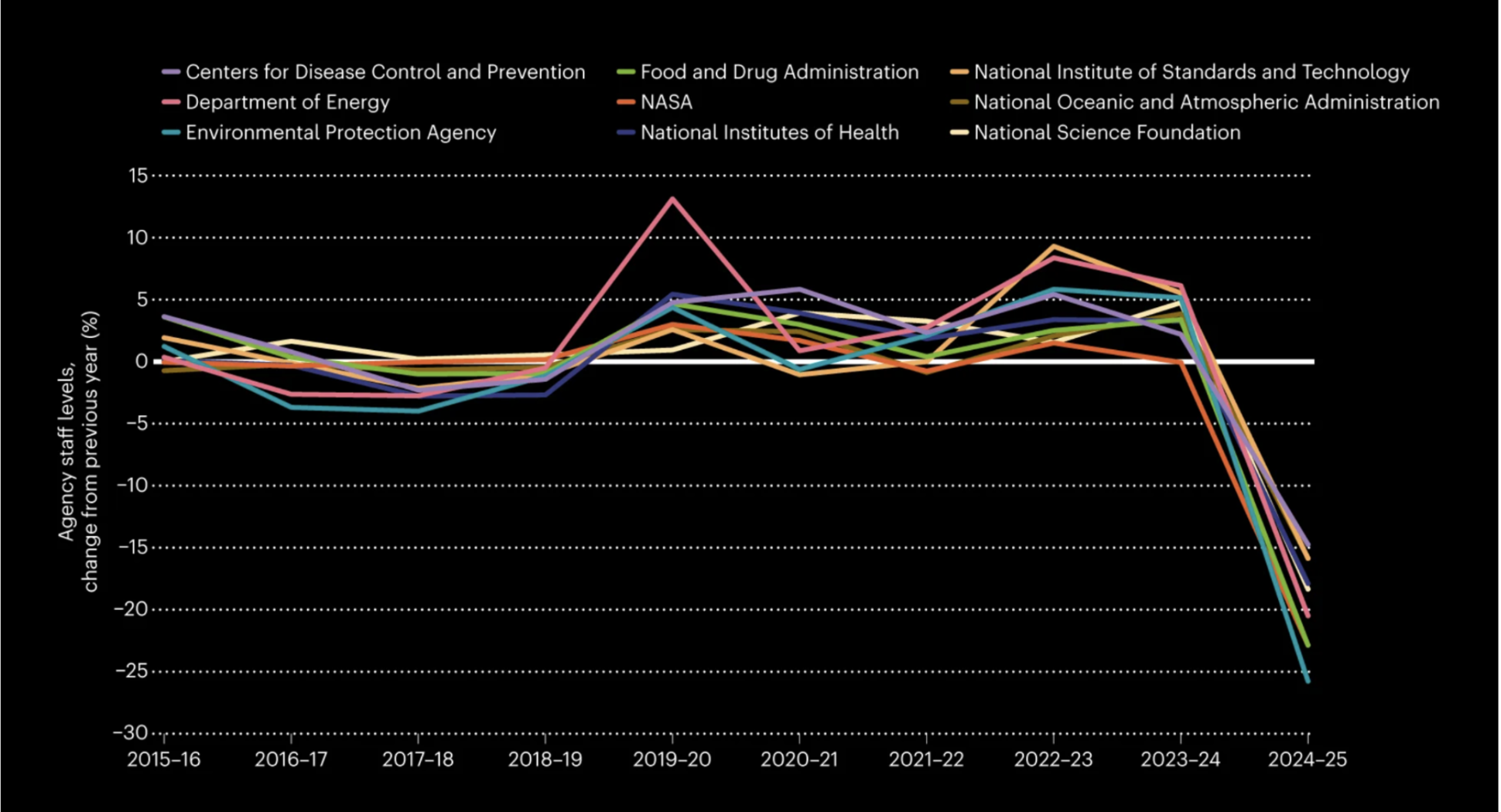
Source: “U.S. science after a year of Trump: what has been lost and what remains.” https://www.nature.com/immersive/d41586-026-00088-9/index.html Nature. January 20, 2026.
Other actions targeted inspectors general across the Federal government as well as other oversight officials, including those in the Office of Special Counsel and Merit Systems Protection Board, limiting the ability of government employees to challenge actions taken by their superiors, challenge illegal firings, or hold political appointees accountable for actions taken. Despite early successes in the courts, including the reinstatement of probationary employees in places like the National Science Foundation,104 thousands of science employees across dozens of agencies have yet to have their cases resolved, thanks in part to the Supreme Court’s pause on forcing agencies to rehire probationary employees.105 Statistics officers were also fired, allowing the President to designate new officials who would hopefully provide him with curated economic assessments.106
The Department of Homeland Security began work on regulations affecting the status of individuals on non-immigrant visas traveling to the United States for the purpose of higher education. This included ending the practice of issuing visas for duration in status, which allowed an individual to stay in the country as long as they remained in academic programs. DHS moved to limit this status to a fixed number of years—four—not long enough for many PhD students to be able to complete their programs.
A subset of actions taken within the Federal government targeting Chinese immigrants working in science and technology areas was issued by U.S. government political staff before being immediately rescinded by President Trump after blowback from the Chinese government. This suggested divergence within the administration on issues like immigration between many of the President’s supporters and the President himself. Despite the President’s public support for such student attendees at universities, reports of visa denials, visit cancellations, and other issues remain widespread.
Resulting Impact
Before diving into actions taken by the administration, it is important to understand that the scope and breadth of attacks on the U.S. science and technology ecosystem also makes it difficult to challenge any individual set of actions. Organizations and Congress have limited time, attention, funding, and scope, and the administration has at almost every instance attempted to “flood the zone,” forcing organizations to prioritize or select which actions to challenge. Likewise, the administration’s willingness to elevate most of its policy actions immediately to the Supreme Court (and the Court’s willingness to use its emergency docket or shadow docket to allow administration actions to proceed while challenges are ongoing) have amplified the cumulative effect of each of these efforts, often resulting in compounding damage as affected individuals and groups are denied the temporary relief necessary to continue going about their lives. This has the impact of effectuating administration policy actions, even if the courts find in favor of affected individuals.
The most significant impact, and one of the hardest to reverse long-term, are from the efforts effectuated by DOGE and OMB toward the deconstruction of the administrative state. Federal research and development was not necessarily in the best shape even in 2024, with an increasing burden of unfunded mandates, lagging infrastructure support investment, and escalating uncertainty as a result of unstable federal budget dynamics over the past two decades. Even if all illegal firings were reversed, many of the employees would be re-entering agencies that have been fundamentally transformed as a result of their absence, and many of the protections afforded by oversight mechanisms effectively eliminated. In total, more than 10,000 PhD scientists and almost 100,000 science employees have been removed from federal positions,107 creating a gaping hole in federal expertise.
These disruptions have had significant impacts on public health and safety.108 Firings likely impacted the administration’s response to screwworm109 and cyclospora outbreaks.110 Firings at the NWS and cuts to weather monitoring have complicated forecasting efforts,111 while cuts to FEMA threaten future disaster response.112
On the federal grants side, there have been significant efforts to catalogue the impact of grant cancellations on the broader research ecosystem, particularly with respect to the largest extramural research and development funders, the NIH and NSF, respectively. GrantWitness has catalogued at the NIH 5,780 disrupted grants (all but 1,231 of which have been restored) and 2,031 at the NSF at the time of this writing (1,400 of which remain disrupted). Other agencies that issue major awards, like the Department of Energy and Department of War, are much more difficult to track given the nature of the awards issued and the fact that some programs are classified or restricted due to the national security nature of the work. Organizations like Science Impacts have attempted to track the economic fallout as a result of agency disruptions that are publicly available, but this picture is, at best, incomplete, given the number of agencies involved in government contracting, the variety of the science missions, and the spillover impacts into the broader economy, especially from mission agencies, like the USDA’s National Institute of Food and Agriculture or the National Marine Fisheries Service.
The funding uncertainty and loss of funding has had significant impacts on universities, who have been forced to reduce the number of students enrolled as they face dual challenges in the face of increasingly complicated financial aid programs, cuts to research and development, and a demographic cliff due to the country’s aging population.113 Declines in PhD enrollment are down for both domestic (13%) and international (17%) students, owing to greater Federal funding uncertainty and increased restrictions on STEM students. Should the administration move forward with enacting a $100,000 fee on Optional Practical Training, the door could be slammed shut for many foreign born, U.S. trained students who make up a significant (35%) portion of the PhD-holders in the U.S. scientific workforce.114
What we can say is that the impact of the government’s banned words list, which were used to flag papers for review, appears to still be in place. Stand Up for Science advisor Jeremy Berg recently produced an analysis characterizing coerced word removal and found that many of the terms used to flag Federal grants in early 2025 are still being removed from grants with non-competitive renewals deep into 2026.115
Exploiting Good Faith Reform Efforts and Flooding the Zone to Limit Opposition
As 2025 progressed, the administration began rolling out a variety of executive orders and policy actions relating to science, such as the executive order on Gold Standard Science and a request for information aimed at recalibrating the federal research and development ecosystem.116 These reports used language targeting long-term policy issues perennially raised in Washington policy circles, such as those related to scientific integrity, reproducibility, administrative burden, and the innovation pipeline, suggesting that this administration might be posed to make gains where others had failed. The Office of Science and Technology Policy sought to implement long-discussed ideas in federal agencies, like metascience units to inform agency programs. Some agencies, like the Department of Energy, began projects like the “Genesis Mission” (primarily a comprehensive rebranding effort around previous work) that elevated work in specific fields while others were subjected to increasingly draconian cuts. In mid-2026, OSTP released Science: A New Golden Age, which was branded as the first comprehensive rethink of the U.S. science and technology ecosystem. The report was largely a regurgitation of earlier policy ideas, a continued attack on universities and centers of traditional knowledge, and a continued effort to redirect efforts toward artificial intelligence-related development.
The strategy largely worked. Reaction from science policy offices inside the beltway reacted cautiously, yet favorably to certain elements of the initiatives, relying on traditional policy opportunism to try to gain and demonstrate relevance in ongoing policy debates. Yet despite the administration’s alleged prioritization of specific fields and assurances from lower-ranking agency leadership, the administration continued to make cuts to programs in agencies, including those supposedly prioritized by the current administration117 and the process of transforming research agencies,118 ostensibly to align with the current administration’s policies, particularly by developing programs that could redirect funding to favored organizations and removing barriers from political interference in the grantmaking process.119 The largest assault, by far, came from the Office of Management and Budget in the form of a proposal to regulate agencies, forcing them to conform with administration priorities, de-emphasizing merit review, and creating layers of additional scrutiny and regulatory risk for grantees.120 Agencies like the National Science Foundation and Department of Education subsequently released proposed updates to their grantmaking systems to pre-align with the OMB proposal, even after it had been stalled by Congress. By positioning the regulation toward federal agencies while forcing them to enact their own implementations of the rulemaking, the administration has positioned themselves to overwhelm efforts to oppose the rule, starving other organizations of the attention necessary to effectively challenge the actions of dozens of different grantmaking federal agencies.
Useful Resources
Grant Witness - tracks a variety of cuts to federal funding agencies
Science & Community Impacts Mapping Project - tracks the broader impact of cuts, including economic fallout
Federal Harms Tracker (Partnership for Public Service) - https://federalharmstracker.org - looks at cost by sector, including workforce, grants, and contract funding
Attacks on Science (Union of Concerned Scientists) - documents specific policy actions taken by the administration, to include policy impacts impacting public participation
EssentialData.US Terminations Tracker (Federation of American Scientists) - Catalogue of federal datasets that have been removed or deleted since January 2025
Silencing Science Tracker (Columbia University) - Catalogue of policy actions taken related to governmental attacks on science since 2016 (not limited to federal policy actions)
Executive Action Watch (Center for Budget and Policy Priorities) - tracks executive actions taken since January 2025 and explains their impacts “on low- and moderate-income people and the programs people use to help meet their essential needs.”

The scientific community is not a single actor with a single playbook. It is a crowded ecosystem: universities, professional societies, the federal scientific workforce, advocacy organizations, faculty, unions, early-career researchers, and individual scientists. These groups occupy different, often overlapping, positions. They have different risk tolerances, different funding dependencies, and different theories of what “scientific responsibility” requires.
That diversity has produced a wide range of responses to the administration’s policies: quiet accommodation, institutional caution, selective statements, and in some quarters, public pushback. What it has not produced is a coherent strategy. For too long, the community treated each grant cancellation, each personnel purge, each rule change, and each targeting of a scientist as a discrete incident rather than as parts of a coordinated effort to subordinate scientific institutions to political control. The result is that the damage has outpaced the response.
The clearest, most consistent voices have come from advocacy organizations, faculty unions, individual scientists, and whistleblowers. Major scientific organizations—the large societies, the flagship institutions, the groups most dependent on federal funding and most protective of their reputation and funding—have been quieter, more measured, and compliant.121 That asymmetry is a predictable feature of an environment in which government policy and informal pressure shapes and reshapes institutional behavior. Historian Timothy Snyder calls this anticipatory compliance, or anticipatory obedience: institutions constrain themselves in advance because the political and material costs of speaking plainly appear too high.122 The more risk-averse an organization is, the more reputation-conscious, and the more dependent it is on federal dollars, the less likely it is to take a clear public stance. Silence, moderation, or carefully hedged language is often a calculation. But so far, the calculation has not afforded these institutions safety from political interference and has led to a loss of trust from members of the scientific community. The burden of naming what is happening falls on other organizations and individuals who often have to risk their own reputation. The fear of being labeled partisan has made it harder for many institutions to say the obvious: subordinating science to ideology is itself a political act, and remaining silent about it is not neutrality.
A slow shift toward a shared political reality
Sentiment is changing, but slowly and unevenly. Two developments in particular have made the systemic nature of the threat harder to ignore. First, OMB’s proposed rewrite of the rules governing federal financial assistance made clear that this is not only about individual grants or agencies. It is about the administrative machinery itself who reviews awards, on what criteria, who can terminate them, and under what conditions. A rule that treats peer review as advisory, requires political appointees to assess whether awards advance the President’s policy priorities, expands mid-award termination authority, and embeds content restrictions into the government-wide grant framework is not a series of discrete attacks. It is a redesign of the conditions under which science is funded.
Second, the public targeting and harassment of prominent scientists has underscored that the pressure does not stop at programs and budgets. It reaches the people who produce and defend scientific knowledge. When scientists go quiet not because they have nothing to say but because they fear retaliation against their funding, their institutions, or themselves, the community is no longer simply debating policy. It is navigating an environment designed to produce self-censorship.
The scientific community is beginning to see the pattern. Seeing it is not the same as organizing a response equal to it. Until the institutions with the most resources and legitimacy treat this as an existential threat rather than a sequence of unfortunate incidents, the response will remain fragmented and the damage will continue.
References
Dans, P., & Groves, S. (Eds.). (2023). Mandate for leadership: The conservative promise. The Heritage Foundation. https://static.heritage.org/project2025/2025_MandateForLeadership_FULL.pdf
Kroll, A. (2025, October 17). The shadow president. ProPublica. https://www.propublica.org/article/russ-vought-trump-shadow-president-omb
U.S. Department of Health and Human Services. (2018, January 18). HHS announces new Conscience and Religious Freedom Division. https://www.hhs.gov/about/news/2018/01/18/hhs-ocr-announces-new-conscience-and-religious-freedom-division.html (archived at PageFreezer, December 31, 2020)
Revolving Door Project. (2026, May 8). PCAST is another lever of corporate influence. https://therevolvingdoorproject.org/pcast-trump-big-tech-ai-crypo-conflicts-of-interest/
Edwards, J. (2026, June 4). Ballroom donors won $50B in contracts after giving to Trump project, watchdog group finds. The Washington Post. https://www.washingtonpost.com/politics/2026/06/04/donors-won-50b-contracts-after-giving-trump-ballroom-project-report-says/
Duran, G. (2026). The nerd reich: Silicon Valley fascism and the war on democracy. Avid Reader Press.
Pasternak, D. S. (2026, August 17). Trump’s billionaire boys club: How Donald Trump has stacked his administration with investment bankers and billionaire businessmen and women. Public Citizen. https://www.citizen.org/article/trump-billionaire-boys-club/
Kukoff, Z., et al. (2025, January). Re: Nomination endorsement for White House Office of Science and Technology Policy leadership [Letter in support of Michael Kratsios]. https://traveltech.org/wp-content/uploads/2025/01/Kratsios-Little-Tech-Letter.pdf
Becker, M. (2025, February 24). Letter to Chairman Cruz and Ranking Member Cantwell endorsing Michael Kratsios’s nomination as director of the Office of Science and Technology Policy. Association of Public and Land-grant Universities. https://www.aplu.org/wp-content/uploads/APLU-Letter-Endorsing-Michael-Kratsios-Nomination-to-OSTP.pdf
Andreessen, M. (2023, October 16). The techno-optimist manifesto. Andreessen Horowitz. https://a16z.com/the-techno-optimist-manifesto/
National Academy of Sciences, National Academy of Engineering, and Institute of Medicine. Major Award Decisionmaking at the National Science Foundation. Washington, DC: National Academies Press, 1994. http://doi.org/10.17226/2268
The White House. “Ensuring Accountability for All Agencies.” Executive Order 14215, February 18, 2025. https://www.whitehouse.gov/presidential-actions/2025/02/ensuring-accountability-for-all-agencies/
The White House. “Ensuring Lawful Governance and Implementing the President’s ‘Department of Government Efficiency’ Deregulatory Initiative.” Executive Order 14219, February 19, 2025. https://www.whitehouse.gov/presidential-actions/2025/02/ensuring-lawful-governance-and-implementing-the-presidents-department-of-government-efficiency-regulatory-initiative/
The White House. “Restoring Gold Standard Science.” May 23, 2025. https://www.regulations.gov/document/NSF-2026-OTR-0001-0002
The White House. “Implementing the President’s “Department of Government Efficiency” Workforce Optimization Initiative.” February 26, 2025. https://www.whitehouse.gov/presidential-actions/2025/02/implementing-the-presidents-department-of-government-efficiency-cost-efficiency-initiative/
U.S. Office of Personnel Management. “New Data Shows Trump Administration’s Progress in Right-Sizing the Federal Bureaucracy.” July 1, 2025. https://www.opm.gov/news/new-data-shows-trump-administration%CA%BCs-progress-in-right-sizing-the-federal-bureaucracy/
U.S. Department of Health and Human Services. “HHS Announces Transformation To Make America Healthy Again.” March 27, 2025. https://www.hhs.gov/press-room/hhs-restructuring-doge.html
U.S. Environmental Protection Agency. “EPA Announces Reduction in Force, Reorganization Efforts to Save Taxpayers Nearly Three-Quarters of a Billion Dollars.” July 18, 2025. https://www.epa.gov/newsreleases/epa-announces-reduction-force-reorganization-efforts-save-taxpayers-nearly-three
U.S. Environmental Protection Agency. “EPA Announces Next Phase of Organic Improvements to Better Integrate Science Agency Offices, Deliver Clean Air, Land, and Water to All Americans.” May 2, 2025.https://www.epa.gov/newsreleases/epa-announces-next-phase-organizational-improvements-better-integrate-science-agency
C&EN. “As the EPA formalizes end of research office, critics fear health impacts.” March 3, 2026. https://cen.acs.org/policy/EPA-closes-independent-research-office/104/web/2026/03
U.S. Department of Health and Human Services. “Make America Healthy Again.” Accessed September 3, 2026. https://www.hhs.gov/maha/index.html
The White House. “Commencing the Reduction of the Federal Bureaucracy.” Executive Order 14217, February 19 2025. https://www.govinfo.gov/content/pkg/DCPD-202500282/pdf/DCPD-202500282.pdf
NASA. “SMD - Science Leadership,” accessed September 2, 2026, https://science.nasa.gov/about-us/org-chart/
NASA Science. Recent Changes to NASA Scientific Advisory Committees.” March 31, 2025. https://science.nasa.gov/astrophysics/programs/physics-of-the-cosmos/community/recent-changes-to-nasa-science-advisory-committees/
U.S. Geological Survey. “Federal Advisory committee for Scientific Quality and Integrity.” Accessed September 3, 2026. https://www.usgs.gov/office-of-science-quality-and-integrity/federal-advisory-committee-science-quality-and-integrity
AIP. “Agency Closing Science Advisory Committees.” March 20,2025. https://www.aip.org/fyi/agencies-closing-science-advisory-committees
U.S. Environmental Protection Agency. “EPA to Accept Nominations for Science Boards.” March 12, 2025. https://www.epa.gov/newsreleases/epa-accept-nominations-science-boards
U.S. Environmental Protection Agency. “Administrator Zeldin Announces Selection of Members to the Clean Air Scientific Advisory Committee.” March 9, 2026. https://www.epa.gov/newsreleases/administrator-zeldin-announces-selection-members-clean-air-scientific-advisory
U.S. Environmental Protection Agency. “Administrator Zeldin Announces Selection of Members to the Science Advisory Board.” April 17, 2026. https://www.epa.gov/newsreleases/administrator-zeldin-announces-selection-members-science-advisory-board
POLITICO. “EPA Fires Science Advisers.” January 28, 2025. https://www.politico.com/news/2025/01/28/epa-fires-science-advisers-00201156
U.S. Department of Health and Human Services. “HHS Takes Bold Step to Restore Public Trust in Vaccines by Reconstituting ACIP.” June 9, 2025. https://www.hhs.gov/press-room/hhs-restore-public-trust-vaccines-acip.html
Reuters. “Kennedy replaces fired US CDC panel members, includes anti-vaccine proponents.” June 12, 2025. https://www.reuters.com/business/healthcare-pharmaceuticals/us-health-chief-kennedy-names-new-members-vaccine-advisory-committee-2025-06-11
Nature. “Entire NSF science advisory board fired by Trump administration.” April 28, 2026. https://www.nature.com/articles/d41586-026-01361-7
U.S. National Science Foundation. “National Science Board (NSB).” accessed September 2, 2026. https://www.nsf.gov/nsb
AP news. “Trump administration fires independent board overseeing the National Science Foundation.” April 27, 2026. http://apnews.com/article/national-science-board-nsf-trump-6a23f3ab1b4c6eb131b4e79d95b3536f
The Office of Management and Budget. “Regulation for Federal Financial Assistance.” May 29, 2026. https://www.regulations.gov/docket/OMB-2026-0034
Axios. “Trump’s federal grant overhaul plan draws strong pushback.” July 9, 2026. https://www.axios.com/2026/07/09/omb-grant-overhaul-pushback
National Academies of Science, Engineering, and Medicine. “Statement by Presidents of the National Academies of Sciences, Engineering, and Medicine on OMB Proposal to Change Federal Grantmaking Process.” https://www.nationalacademies.org/news/statement-by-presidents-of-the-national-academies-of-sciences-engineering-and-medicine-on-omb-proposal-to-change-federal-grantmaking-process
Reuters. “US judge says Trump administration cannot revoke grants that conflict with its priorities.” July 17, 2026. https://www.reuters.com/world/trump-administration-cannot-cancel-grants-disfavored-causes-us-judge-rules-2026-07-17
AIP. “Congress Delays OMB Grantmaking Rule with Stopgap Funding Bill.” September 2, 2026. https://www.aip.org/fyi/congress-delays-omb-grantmaking-rule-with-stopgap-funding-bill
U.S. Department of Education. “Education Department General Administrative Regulations.” August 24, 2026. https://www.federalregister.gov/documents/2026/08/24/2026-17239/education-department-general-administrative-regulations
The Guardian. “House passes funding bill to avoid shutdown before midterms.” September 1, 2026. https://www.theguardian.com/us-news/2026/sep/01/house-bill-prevents-government-shutdown
The White House. “Improving Oversight of Federal Grantmaking.” August 7, 2025. https://www.whitehouse.gov/presidential-actions/2025/08/improving-oversight-of-federal-grantmaking/
U.S. National Science Foundation. “Agency Information Collection Activities; Proposals, Submissions, and Approvals: National Science Foundation Proposal/Award Information Guidance on Financial Assistance.” June 24, 2026. https://www.regulations.gov/document/NSF-2026-OTR-0001-0002
The White House. “Restoring Accountability To Policy-Influencing Positions Within the Federal Workforce.” January 20, 2025. https://www.whitehouse.gov/presidential-actions/2025/01/restoring-accountability-to-policy-influencing-positions-within-the-federal-workforce/
PBS News. “Meet the health care critics Trump picked to lead top U.S. health agencies under RFK Jr.” November 27, 2024. https://www.pbs.org/newshour/politics/meet-the-health-care-critics-trump-picked-to-lead-top-u-s-health-agencies-under-rfk-jr
AP News. “Senate confirms Zeldin to lead Environmental Protection Agency as Trump vows to cut climate rules.” January 29, 2025. https://apnews.com/article/trump-cabinet-zeldin-epa-climate-change-9f0def092a907deb5209c2b9ac14a81d
Nature. “Academia at risk.” January 27, 2023. https://www.nature.com/articles/s41562-023-01526-8
National Academies of Sciences, Engineering, and Medicine. “Science, Technology, and The Federal Government: National Goals for a Near Era.” 1993. https://www.nationalacademies.org/publications/9481
Ardnt, Melanie. “Environmentalism or sausages? Politicizing the environment in the late Soviet Union.” European History Quarterly 52(3), 418-439. https://journals.sagepub.com/doi/10.1177/02656914221103152
Leng, Ning & Plantan, Elizabeth. “Disappearing Research: Academic Control and Self-Censorship in China.” The China Journal 94 (2025): 107-133. https://www.journals.uchicago.edu/doi/abs/10.1086/735160
PBS NewsHour. “Major climate change reports are removed from U.S. websites.” July 1, 2025. https://www.pbs.org/newshour/science/major-climate-change-reports-are-removed-from-u-s-websites
National Oceanic and Atmospheric Administration, “National Oceanic and Atmospheric Administration.” https://www.noaa.gov/
NPR. “Ex-NOAA employees re-create a valuable climate data site shut down by Trump.” June 26, 2026. https://www.npr.org/2026/06/26/nx-s1-5869615/climate-noaa-data-trump-doge
Axios. “HIV, transgender care, climate change, and other federal websites go dark.” January 31, 2025. https://www.axios.com/2025/01/31/health-cdc-websites-data-removed-trump
U.S. National Institutes of Health. “Mendelian Inheritance.” Accessed September 19, 2026. https://www.genome.gov/genetics-glossary/Mendelian-Inheritance
Britannica. “Nikolai Vavilov.” Accessed September 19, 2026. https://www.britannica.com/biography/Nikolai-Vavilov
Britannica. “Trofim Lysenko. Accessed September 19, 2026. https://www.britannica.com/biography/Trofim-Lysenko
Borinskaya, Svetlana A., Ermolaeve, Andrei I., and Kolchinsky, Eduard I. “Lysenkoism Against Genetics: The Meeting of Lenin All-Union Academic of Agricultural Sciences of August 1948, Its Background, Causes, and Aftermath.” Genetics 212, no. 1 (2019): 1-12. https://pmc.ncbi.nlm.nih.gov/articles/PMC6499510/
Carnegie Mellon University Encyclopedia of the History of Science. “Lysenkoism.” Accessed September 19, 2026. https://ethos.lps.library.cmu.edu/article/id/560/
Soyer, Valery N. “The Consequences of Political Dictatorship for Russian Science.” Nature Reviews Genetics 2, no. 9 (2001): 723-729. https://pubmed.ncbi.nlm.nih.gov/11533721/
Gligorić, Vukašin, Gerben A. van Kleef, and Bastiaan T. Rutjens. “How Social Evaluations Shape Trust in 45 Types of Scientists.” PLOS ONE 19, no. 4 (2024): e0299621. https://journals.plos.org/plosone/article?id=10.1371/journal.pone.0299621
The U.S. National Institutes of Health. “National Institute of Allergy and Infectious Diseases.” https://www.niaid.nih.gov/
Reuters. “Trump ends US security for Fauci, the latest ex-official to lose protection.” January 24, 2025. https://www.reuters.com/world/us/trump-says-he-ended-security-former-top-covid-official-anthony-fauci-2025-01-24/
Reuters. “Trump’s White House launches COVID website that criticizes WHO, Fauci and Biden,” April 18, 2025. https://www.reuters.com/business/healthcare-pharmaceuticals/trumps-white-house-launches-covid-website-that-criticizes-who-fauci-biden-2025-04-18/
Steele, Molly K. et al. “Estimated Number of COVID-19 Infections, Hospitalizations, and Deaths Prevented Among Vaccinated Persons in the US, December 2020 to September 2021.” JAMA Network Open 5, no. 7 (2022): e2220385. https://jamanetwork.com/journals/jamanetworkopen/fullarticle/2793913
The White House. “Remarks by President Trump in Press Briefing.” August 8, 2020. https://trumpwhitehouse.archives.gov/briefings-statements/remarks-president-trump-press-briefing-080920/
N.I. Vavilov Institute of General Genetics. “History of the Institute.” Accessed September 19, 2026. http://en.vigg.ru/istorija-instituta/history/
Liu, Yongsheng, Li, Baoyin, and Wang, Qinglian. “Science and Politics.” EMBO Reports 10, no. 9 (2009): 938–939. https://pmc.ncbi.nlm.nih.gov/articles/PMC2750069/
The U.S. Center for Disease Control and Prevention. “ACIP.” Accessed September 19, 2026. https://www.cdc.gov/acip/index.html
U.S. Department of Health and Human Services. “HHS Takes Bold Step to Restore Public Trust In Vaccines By Reconstituting ACIP.” June 9, 2025. https://www.hhs.gov/press-room/hhs-restore-public-trust-vaccines-acip.html
Reuters. “Kennedy replaces fired US CDC panel members, includes anti-vaccine proponents.” June 12, 2025. https://www.reuters.com/business/healthcare-pharmaceuticals/us-health-chief-kennedy-names-new-members-vaccine-advisory-committee-2025-06-11/
STAT. “A closer look at the new members of the CDC vaccine advisory panel.” June 11, 2025. https://www.statnews.com/2025/06/11/rfk-jr-vaccine-advisory-panel-new-acip-members-include-mrna-skeptics-covid-critics/
FactCheck.org. “RFK Jr.’s Flawed Justifications for ‘Clean Sweep’ of CDC Vaccine Advisory Panel.” June 18, 2025.
Chu, Helen Y., Brewer, Noel T., Austrias, Edwin J. et al. “The Path Forward for Vaccine Policy in the United States.” New England Journal of Medicine 393, no. 8 (2025): 817–822. https://www.nejm.org/doi/full/10.1056/NEJMsb2509134
U.S. Department of Health and Human Services. “Gold Standard Science at HHS.” Accessed September 19, 2026. https://www.hhs.gov/gss/index.html
Brandt, Allan M. “Inventing Conflicts of Interest: A History of Tobacco Industry Tactics.” American Journal of Public Health 102, no. 1 (2012): 63–71. https://ajph.aphapublications.org/doi/full/10.2105/AJPH.2011.300292
U.S. Department of Health and Human Services. “The Health Consequences of Smoking—50 Years of Progress: A Report of the Surgeon General.” Accessed September 20, 2026. https://www.ncbi.nlm.nih.gov/books/NBK294310/
National Library of Medicine. “The Reports of the Surgeon General: The 1964 Report on Smoking and Health.” Accessed September 20, 2026. https://profiles.nlm.nih.gov/spotlight/nn/feature/smoking
Michaels, David, and Monforton, Celeste. “Manufacturing Uncertainty: Contested Science and the Protection of the Public’s Health and Environment.” American Journal of Public Health 95, suppl. 1 (2005): S39–S48. https://pubmed.ncbi.nlm.nih.gov/17119200/
U.S. Environmental Protection Agency. “Endangerment and Cause or Contribute Findings for Greenhouse Gases Under Section 202(a) of the Clean Air Act.” Accessed September 20, 2026. https://www.epa.gov/climate-change/endangerment-and-cause-or-contribute-findings-greenhouse-gases-under-section-202a
U.S. Environmental Protection Agency. “Final rule: Rescission of the Greenhouse Gas Endangerment Finding and Motor Vehicle Greenhouse Gas Emission Standards Under the Clean Air Act.” Accessed September 20, 2026. https://www.epa.gov/regulations-emissions-vehicles-and-engines/final-rule-rescission-greenhouse-gas-endangerment
Reuters. “Trump rakes in millions at Texas fundraisers, promising pipelines and fracking.” May 24, 2025. https://www.reuters.com/world/us/promising-pipelines-fracking-trump-rakes-millions-texas-fundraisers-2024-05-23/
U.S. National Institutes of Health. “Rescission of the Final Scientific Integrity Policy of the National Institutes of Health.” March 28, 2025. https://grants.nih.gov/grants/guide/notice-files/NOT-OD-25-080.html
U.S. National Institutes of Health. “NIH Publishes Plan to Drive Gold Standard Science,” August 22, 2025. https://www.nih.gov/about-nih/nih-director/statements/nih-publishes-plan-drive-gold-standard-science
Euro news. “Hungary to stop financing gender studies courses - PM aide.” August 14, 2018. https://www.euronews.com/2018/08/14/hungary-to-stop-financing-gender-studies-courses-pm-aide
Fielding-Miller, Rebecca et al. “Targeted termination of scientific grants and minoritised research status in a national survey: a cross sectional analysis. The Lancet Regional Health - Americas. May 5, 2026. https://www.thelancet.com/journals/lanam/article/PIIS2667-193X(26)00108-0/fulltext
Millier, Amitai S. et al. “Termination of Gender-Affirming Care Grants at the National Institutes of Health.” JAMA Pediatrics. November 17, 2025. https://pubmed.ncbi.nlm.nih.gov/41247747/
Laplante, Stacie K. et al. “Limits of Tax Regulation: Evidence from Strategic R&D Classification and the R&D Tax Credit.” Journal of Accounting and Public Policy 38, no. 2 (2019): 89–105. https://www.sciencedirect.com/science/article/pii/S0278425419300651
White House Office of Science and Technology Policy. “Quadrennial Science and Technology Review Report.” September 2024. https://www.govinfo.gov/content/pkg/CMR-PREX23-00190980/pdf/CMR-PREX23-00190980.pdf
Office of the Under Secretary of War (Comptroller). “RDT&E Programs (R-1): Department of War Budget, Fiscal Year 2027.” April 2026. https://comptroller.war.gov/Portals/45/Documents/defbudget/FY2027/FY2027_r1.pdf
American Association for the Advancement of Science. “FY 2026 R&D Appropriations Dashboard.” https://www.aaas.org/news/fy-2026-rd-appropriations-dashboard
Kelly, Erin. “House Passes Bill Boosting Funds for National Weather Service Staffing.” Spectrum News 1. January 12, 2026. https://spectrumnews1.com/ky/louisville/news/2026/01/12/house-national-weather-service-
Fritzhand, Noah. “NOAA’s Critical Contributions to US National Security.” Council on Strategic Risks. March 5, 2025. https://councilonstrategicrisks.org/2025/03/05/noaas-critical-contributions-to-us-national-security/
United for Medical Research. “NIH’s Role in Sustaining the U.S. Economy: FY2025.” 2026. https://www.unitedformedicalresearch.org/annual-economic-report/
Donovan, Cole, and Skip Vaughn. “Bringing Transparency to Federal R&D Infrastructure Costs.” Federation of American Scientists. July 25, 2025. https://fas.org/publication/federal-rd-infrastructure-costs/
Ballotpedia. “Donald Trump’s Executive Orders Issued on the First Day of His Second Term, 2025.” https://ballotpedia.org/Donald_Trump%27s_executive_orders_issued_on_the_first_day_of_his_second_term,_2025
Trump, Donald J. “Establishing and Implementing the President’s ‘Department of Government Efficiency.’” Executive order. January 20, 2025. https://www.whitehouse.gov/presidential-actions/2025/01/establishing-and-implementing-the-presidents-department-of-government-efficiency/
Heckman, Jory. “How Healthcare.gov’s Botched Rollout Led to a Digital Services Revolution in Government.” Federal News Network. July 30, 2025. https://federalnewsnetwork.com/technology-main/2025/07/how-healthcare-gov-botched-rollout-led-to-a-digital-services-revolution-in-government/
Katz, Eric. “The 5 Biggest Stories Federal Agencies and Employees Need to Watch in 2026.” Government Executive. December 30, 2025. https://www.govexec.com/management/2025/12/5-biggest-stories-federal-agencies-and-employees-need-watch-2026/410319/
Oliveira, Diego F. M. et al. “How the 2025 NIH Grant Terminations Varied by Researchers’ Demographic Groups.” Proceedings of the National Academy of Sciences 123, no. 13 (2026): e2527755123. https://www.pnas.org/doi/10.1073/pnas.2527755123
Barshay, Jill. “How Trump 2.0 Upended Education Research and Statistics in One Year.” The Hechinger Report. December 1, 2025. https://hechingerreport.org/proof-points-trump-upended-education/
Elliott, Vittoria. “The Census Bureau Is Overrun With Staffers From a MAGA Think Tank.” Wired. September 15, 2026. https://www.wired.com/story/a-trump-aligned-think-tank-focused-on-voting-rights-has-taken-over-the-census-bureau/
FedScoop. “NSF Says It’s Reinstating Fired Probationary Employees.” March 3, 2025. https://fedscoop.com/nsf-says-its-reinstating-fired-probationary-employees/
Liptak, Adam. “Supreme Court Pauses Ruling Requiring Trump to Rehire Thousands of Federal Workers.” The New York Times. April 8, 2025. https://www.nytimes.com/2025/04/08/us/politics/supreme-court-probationary-workers.html
The Guardian. “Labor Statistics Chief Fired by Trump Sounds Alarm over White House’s ‘Dangerous’ Interference.” September 17, 2025. https://www.theguardian.com/business/2025/sep/17/labor-statistics-chief-trump-erika-mcentarfer
Goldman, Gretchen. “Update: Attacks on Independent Science and How We’re Fighting Back.” Union of Concerned Scientists. July 22, 2026. https://blog.ucs.org/gretchen-goldman/update-attacks-on-independent-science-and-how-were-fighting-back/
Partnership for Public Service. “The Cost of Cutting American Science: How Federal Cuts Diminish Public Health Capacity.” June 2, 2026. https://ourpublicservice.org/know-the-facts/resource-library/reports/the-cost-of-cutting-american-science-how-federal-cuts-diminish-public-health-capacity
Brown, Marcia. “Trump Reviews Slowed Screwworm Response, Former Officials Say.” Politico. June 17, 2026. https://www.politico.com/news/2026/06/17/trump-reviews-slowed-screwworm-response-00964448
Noguchi, Yuki. “Record Cyclosporiasis Outbreak Tests the Response of a ‘Weakened’ Health System.” NPR. August 20, 2026. https://www.npr.org/2026/08/20/nx-s1-5930462/trump-health-foodborne-illness-outbreak-cyclospora
Czachor, Emily Mae. “Weather Service Faces Hurricane Season with Less Experienced Staff, Missing Data.” CBS News. July 20, 2026. https://www.cbsnews.com/news/national-weather-service-hurricane-season-less-experienced-staff-missing-data/
U.S. Government Accountability Office. “FEMA Workforce: Staff Reductions and Lack of Planning May Impact Mission Readiness.” GAO-26-108427. August 4, 2026. https://www.gao.gov/products/gao-26-108427
Marcus, Jon. “The Number of 18-Year-Olds Is About to Drop Sharply, Packing a Wallop for Colleges — and the Economy.” The Hechinger Report. January 8, 2025. https://hechingerreport.org/the-impact-of-this-is-economic-decline/
Clemens, Michael A., Jeremy Neufeld, and Amy M. Nice. “Class Dismissed: The Effect of International Student Exclusion on the US STEM Workforce and Economic Growth.” Policy Brief 26-10. Peterson Institute for International Economics. June 2026. https://www.piie.com/publications/policy-briefs/2026/class-dismissed-effect-international-student-exclusion-us-stem
Berg, Jeremy M. “Characterizing Coerced Word Removal from NIH Grants in Fiscal Year 2026.” Stand Up for Science Foundation. September 10, 2026. https://www.standupforscience.foundation/policy-and-advocacy/characterizing-coerced-word-removal-from-nih-grants-in-fiscal-year-2026
Office of Science and Technology Policy. “Notice of Request for Information; Accelerating the American Scientific Enterprise.” Federal Register 90, no. 226 (November 26, 2025): 54412–54413. https://www.federalregister.gov/documents/2025/11/26/2025-21150/notice-of-request-for-information-accelerating-the-american-scientific-enterprise
Garisto, Dan. “NSF Plans Cuts to Core Science Programmes to Fund White House Initiative.” Nature. July 10, 2026. https://www.nature.com/articles/d41586-026-02135-x
Mervis, Jeffrey. “NSF Memo Implementing Trump’s ‘Golden Age’ of Science Unsettles Researchers.” Science. September 14, 2026. https://www.science.org/content/article/nsf-memo-implementing-trump-s-golden-age-science-unsettles-researchers
McKenzie, Lindsay. “Science Agencies Pull ‘Political Interference’ Protections From Scientific Integrity Policies.” FYI, American Institute of Physics. September 11, 2026. https://www.aip.org/fyi/science-agencies-pull-political-interference-protections-from-scientific-integrity-policies
Levin, Adam G. “May 2026 Proposed Rule on Uniform Guidance for Federal Grants: Summary of Selected Changes.” CRS Insight IN12697. Congressional Research Service. Updated September 11, 2026. https://www.congress.gov/crs-product/IN12697
Cornwall, Warren. “Trump’s ‘Fear Factor’: Scientists Go Silent as Funding Cuts Escalate.” Science 388, no. 6748 (May 12, 2025): 684–85. https://www.science.org/content/article/trump-s-fear-factor-scientists-go-silent-funding-cuts-escalate.
Snyder, Timothy. On Tyranny: Twenty Lessons from the Twentieth Century. New York: Tim Duggan Books, 2017.