
Characterizing Coerced Word Removal from NIH Grants in Fiscal Year 2026
By Jeremy M. Berg PhD, Stand Up for Science Advisor
Initial Observations
The National Institutes of Health (NIH) under the current administration has been disrupting and terminating research and training grants on the grounds that they “no longer effectuate the program goals or agency priorities.” Many of these disruptions are connected to “DEI” as articulated in an early Executive Order. This presents “DEI,” without much definition, as a recent priority. But NIH, with considerable support and pressure from Congress, has developed programs to increase representation of groups historically underrepresented in biomedical research, including racial and ethnic minorities, women, individuals with disabilities, and others, going back to the 1970s.
In contrast to this congressional mandate, NIH staff are now charged with reviewing both new and existing grant applications for “misalignment” with “agency priorities” and enforcing changes when this is the case. This process has been called “renegotiation” or even “remediation.” However, there has been relatively little transparency into the process. Some of the early grant flagging was apparently done by individuals associated with DOGE, or by program officers or grants management specialists working under orders. However, more information is generally not made public in any way and investigators and institutions, interested in getting their grants funded, rarely discussed the process.
For most NIH grants which are awarded for more than one year, funding for the second and subsequent years are contingent on the submission of a scientific and financial progress report. These reports are reviewed both by program officers (doctorate-level scientists) who review the scientific progress and the plans for the upcoming grant period, and by grants management specialists who review spending and compliance with the terms and conditions of the grant award. Under normal circumstances, 98-99% of these non-competitive renewal grants are funded, sometimes after some back-and-forth between the principal investigator and their institution and NIH staff.
In August 2025, a colleague of mine made an offhand comment to me that a grant he was involved with had finally had its non-competitive renewal grant awarded, but only after they had modified the title and abstract. This is a sad state of affairs but also presented an opportunity to bring some visibility into the scope and characteristics of the “renegotiation” process. What words and phrases are not “in alignment”? Conveniently, titles and abstracts for funded grants are publicly available on the NIH Reporter website. Under normal circumstances, titles do not change from year to year, and abstracts also often remain unchanged. But if titles are being changed in response to these renegotiations, then this should be trackable using publicly available data.
I downloaded the relevant records from NIH Reporter and looked for grants that had been funded in fiscal year 2024 and were due for non-competitive renewal awards in fiscal year 2025. If such awards had been made, I compared their 2024 and 2025 titles. For the 777 awards I found, some had insignificant changes such as typo corrections. For others, however, very specific words had been removed.
To visualize the changes, I uploaded the removed words into a commercial word cloud generator. The resulting word cloud confirmed my suspicions.
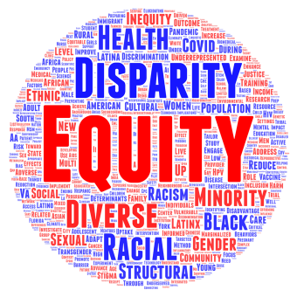
Fig. 1
Word cloud of removed words from 777 grants with non-competitive renewals funded in fiscal year 2025.
I posted the results of this analysis on Bluesky. This was picked up by the press and a story soon appeared about these “banned words” that NIH leadership had repeatedly claimed did not exist. NIH has subsequently confirmed that they have developed a computer-based screening tool that examines grant applications to look for terms that are “not aligned with agency priorities.” NIH Director Jayanta Bhattacharya claims that program staff are not or should not be using this tool for identifying terms out of alignment, but this is contrary to the practice being imposed on program officers. For example, at the 2026 Coordinating Center on the Economics of AD/ADRD Prevention Treatment (minute 29), he was asked by an NIH program officer if he was “aware that your program staff are being asked to remove words from applications and to tell applicants to remove words from applications?” He responded, “That’s against my orders. There is no banned word list. You have heard how I want to do this. If they are telling you to remove words, they should not be telling you do to that.”
It is not clear who “they” is in this sentence but reports from NIH program staff indicate that “they” includes Jon Lorsch, Deputy Director for Extramural Research, the most senior grants official at NIH. Either Director Bhattacharya is unaware of how the agency he is charged to lead is conducting its business, or he is engaged in high level gaslighting of his staff and the public.
Results for Fiscal Year 2026
I have now repeated this analysis for non-competitive renewal grants funded in the current fiscal year (fiscal year 2026). The results are remarkably similar to those seen previously. Of approximately 25,000 non-competitive renewal awards, slightly over 600 have one or more words added or removed. The word most commonly missing was “Alzheimers.” Examination revealed that this was due to changes from “Alzheimers” to the correct form “Alzheimer’s” for 135 grants. I removed “Alzheimers,” “Parkinsons” and “Childrens” from the list since these were common changes made as corrections, rather than for some other reason. I also omitted words that were removed from only a single grant since these were mostly typo corrections or similar and, in any case, do not occur frequently.
The remaining 556 removed words were visualized using the word cloud generator.
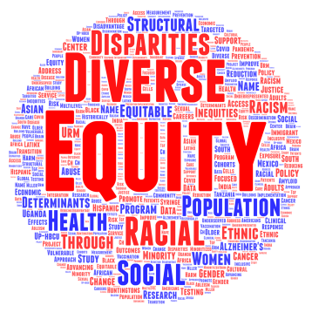
Figure 2.
Word cloud of removed words from approximately 500 grants with non-competitive renewals funded in fiscal year 2026.
This is strikingly similar to what I observed in the previous fiscal year. The most commonly removed words were “Equity” (25 occurrences), “Diverse” (24 occurrences), “Racial” (14 occurrences), “Social” (12 occurrences), and “Disparities” (12 occurrences).
To provide more context about these changes, here is a set of selected changes:
… Intervention to Improve HIV Prevention Service Engagement and Intersectional Stigma among Racially Diverse Women Who Use Drugs
to
… Intervention to Improve HIV Prevention Service Engagement among People Who Use Drugs
Social Determinants of Vision Health in Children
to
Preventing Vision Loss in Childhood
…. An Academic and Community Alliance to Eliminate Disparities throughout the Fibroid Experience…
to
… An Academic and Community Alliance to Eliminate Differences throughout the Fibroid Experience…
Improving the delivery and equity of inpatient palliative care: a hybrid type I pragmatic cluster trial
to
Improving the delivery of inpatient palliative care: a hybrid type I pragmatic cluster trial
Research Education Program to Promote Diversity in Immunologic and Allergic Diseases
to
Research Education Program in Immunologic and Allergic Diseases
Recruitment and Retention for Alzheimer's Disease Diversity Genetic Cohorts in the ADSP
to
Recruitment and Retention for Alzheimer's Disease Detailed Genetic Cohorts in the ADSP
and
Promoting Equity of Cancer Screening and Follow-up for Lung Cancer.
to
Promoting Improvements in Screening and Follow-up for Lung Cancer in Rural Communities
These changes are clearly based on specific words rather than a more detailed analysis of concepts. For example, the following change was made.
Viral Diversity an Innovative Biomarker for Refining Estimates of HIV Incidence
to
HIV-1 Genetic Variability as a Biomarker to Refine HIV Incidence Estimates
“Viral Diversity” relates to the population of HIV virus genomes present and does not have any connection to diversity of the human population. This was replaced with “HIV-1 Genetic Variability.” This is a reasonable change, but it seems likely that this change was made because the term “diversity” was flagged by the NIH screening tool, rather than a content-based analysis.
Efficiency of Word Removal
It is not clear how efficiently these terms were removed across NIH grants. This is especially true since many of the terms removed from grant titles might be used in other contexts. I focused on 36 terms: equity, disparities, social, determinants, equitable, populations, racial, racism, gender, inequities, Africa, African, Black, diversity, Latinx, minority, racially, ableism, discrimination, underrepresented, underserved, cultural, disadvantage, Hispanic, historically, immigrant, inequalities, justice, Mexico, minorities, minoritized, racially/ethnically, sexual, Tanzania, Uganda, and vulnerable.
I compared the number of grant titles containing these words that were due for a non-competitive renewal in fiscal year 2025 with the number of those from titles from which the words were removed.
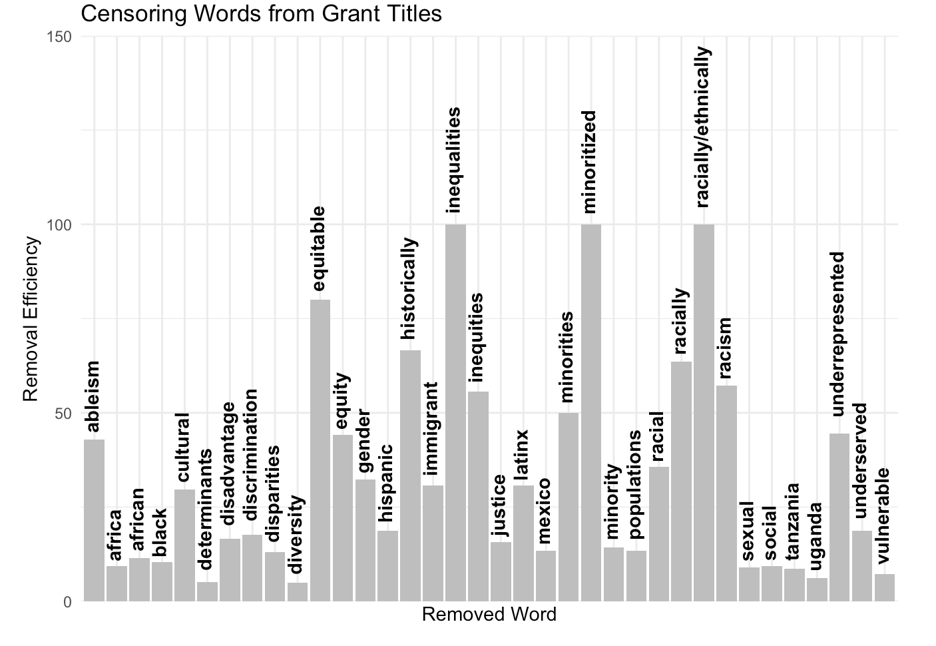
Figure 3. The percentage of eligible grant titles from fiscal year 2025 containing one of the selected words from which the word was removed.
The results show that the terms “inequalities,” “minoritized” and “racially/ethnically” were removed every time they occurred. The overall average removal efficiency was 11.5%.
I also examined the distribution of these grants across NIH Institutes and Centers.
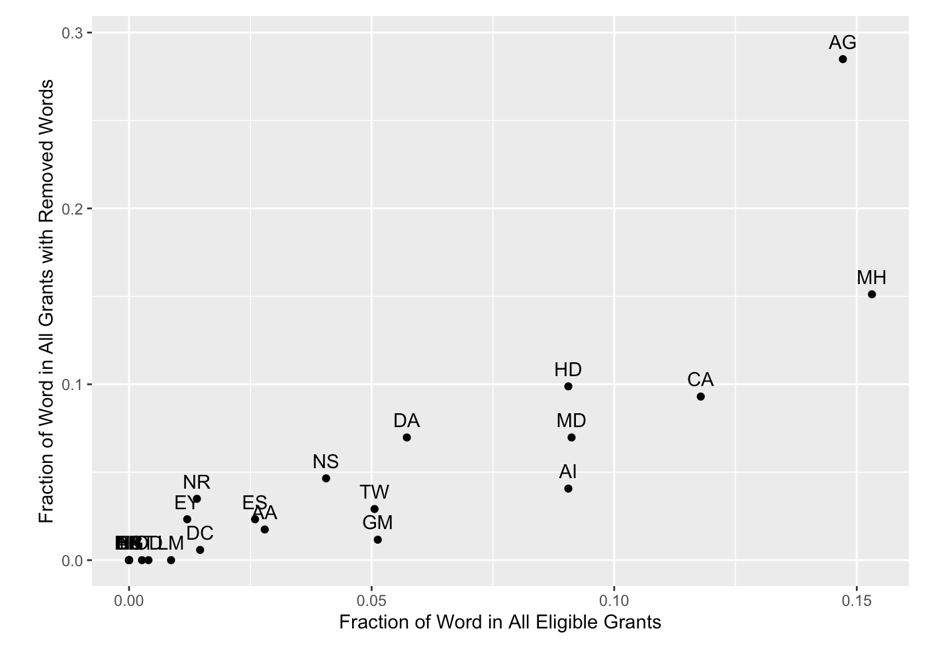
Figure 4. The distribution of word removal across NIH institutes and centers, designated with two-letter abbreviations.
The relatively linear trend shows that, overall, all institutes and centers removed words from a similar fraction of the eligible grants that contained those words. The overall Pearson correlation coefficient is 0.87.
Taken together, these observations suggest that the renegotiation process is being driven by the Office of the Director or other centralized office such as the Office of Extramural Research.
Conclusions
The removal of words and terms from NIH grants upon the awarding of non-competitive renewals continues much as it occurred in fiscal years 2024 to 2025. These changes are made by principal investigators and institutions under coercion from NIH about changes that are required in order for grants to be funded. It is unclear how much this affects the actual research being conducted, as opposed to the language used to describe it, although this may be amenable to analysis over time. Moreover, this approach certainly underestimates the true changes since other changes in scope or approach must be occurring without changes in grant titles. The censorship is radically different from anything that I have seen at NIH in the more than 40 years that I have been interacting with this agency. It is detrimental to science and to stewardship of public funds.