
Everything You Need to Know About RFK Jr.’s Guinea-Bissau Newborn Vaccine Trial
By Colette Delawalla PhD, SUFS Foundation CEO & Founder and Brynn Paulsen PhD, SUFS Foundation Director of Research
A gap in access to well established safe and effective vaccines should be handled by filling that gap. It should not become an opportunity to exploit that gap in pursuit of disproven theories.
Unfortunately, the Department of Health and Human Services secretary Robert F. Kennedy Jr. is doing just that by funding a study in Guinea-Bissau–a study that would assign half of the newborn subjects to go without the hepatitis B birth dose so that researchers can investigate broader health impacts[1]. This unnecessary research–given decades of evidence supporting the vaccines safety–has previously drawn public condemnation from the World Health Organization (WHO)[2], which warns that the conspiracy-driven safety concerns do not ethically justify withholding proven protection from newborns.
By utilizing American taxpayer dollars to pursue alternative theories for well-established science, RFK Jr. is unnecessarily exploiting the lives of children, perpetuating the risk they already face to pursue his agenda instead of utilizing the funding to help children abroad with robustly safe vaccines. Below, we break down what exactly is happening, what we already know about the hepatitis B vaccine, what the major ethical concerns are regarding this study, and what the long-term impact of such an undertaking may be.
What is happening?
The current iteration of the Guinea-Bissau study constitutes the second attempt at conducting this line of research[3]. At the end of 2025, the Center for Disease Control and Prevention (CDC) awarded $1.6 million to the University of Southern Denmark to conduct a study on the health impacts (outside of disease protection) of the hepatitis B vaccine in 14,000 newborns in Guinea-Bissau. This proposal drew widespread objections over the risks of leaving newborns without well-established protection. Stand Up for Science previously investigated the study’s funding and approval process and challenged the ethical and scientific foundation of the study[4]. The resulting wave of public outcry resulted in the University of Southern Denmark placing the study on hold in February of 2026.
This was not the end. Despite the public outcry, the university leadership has approved proceeding with a minimally revised protocol. The noted changes related to public concerns include:
● Limited Screening–the study will now ask mothers about their hepatitis B status, and 250 mothers and children will be screened for infection (~2% of the total sample population)
No further revisions could be established by the Rolling Stone, who first broke news of the continuation of this study. Otherwise, the plan still includes giving the hepatitis B vaccine birth dose to half of the 14,000 newborns, with the other half still going without the dose. At present, the study is awaiting final approval from the Guinea-Bissau authorities to provide the necessary national authorization before continuation.
What do we already know about the hepatitis B vaccine?
The protection afforded by the birth dose hepatitis B vaccine is well-established, and its safety has been examined through clinical studies and decades of monitoring. Below, we summarize the knowledge already established by prior research.
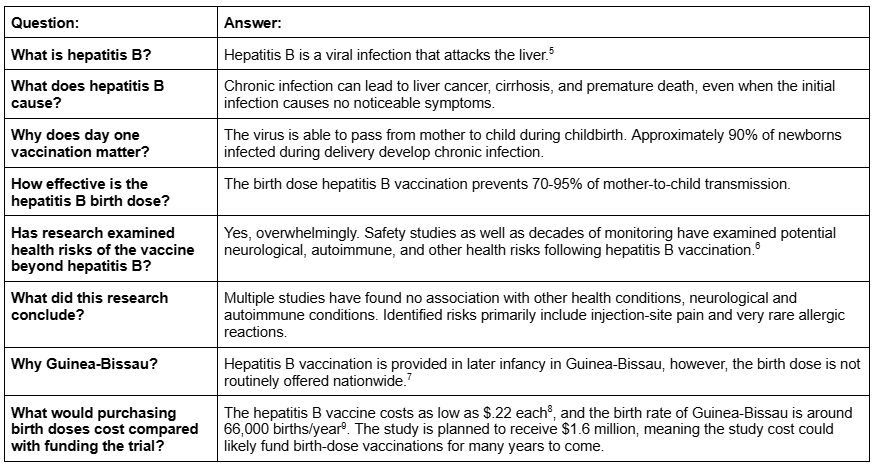
The hepatitis B vaccine costs as low as $.22 each, and the birth rate of Guinea-Bissau is around 66,000 births/year. The study is planned to receive $1.6 million, meaning the study cost could likely fund birth-dose vaccinations for many years to come.
There is overwhelming evidence this affordable, life-saving vaccine is both effective and safe. In Guinea-Bissau, this birth dose vaccine is an urgent priority, given the health risks associated with hepatitis B. Using this access gap in Guinea-Bissau to pursue anti-vaccine theories in a nation disadvantaged in its access to public health care–instead of providing accessible care, at a presumably far lower cost than the study’s funding allocation–raises serious ethical concerns, which we turn to next.
Ethical Violations
A gap in access to proven lifesaving healthcare is not an ethically valid justification for exposing newborns to preventable harm–it is a reason to provide proven protection to a disadvantaged population. In the United States, we have well-established frameworks for considering the ethical validity of a given study on human populations, outlined in documents such as the Belmont Report[10] and the Declaration of Helsinki[11]. The ethical concerns surrounding this study are extensive, and outlined below.
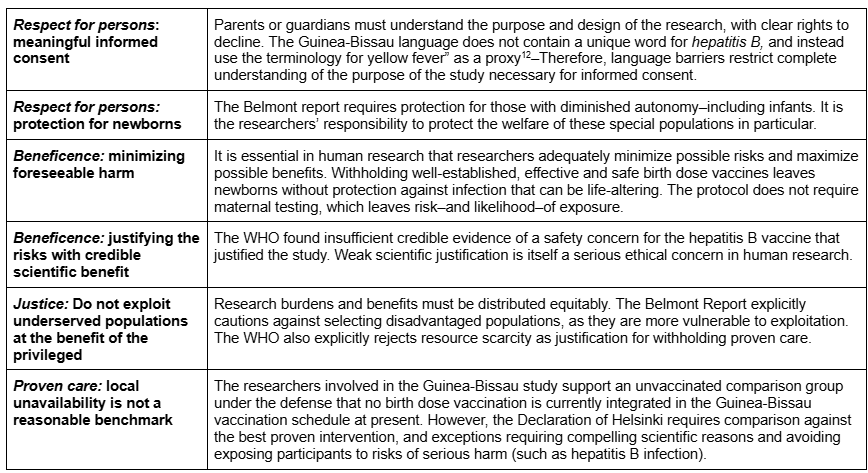
The response in this scenario most consistent with respect for persons, beneficence, and justice would be to close the gap in care by providing access to lifesaving vaccination–not taking advantage of its lacking in a disadvantaged population in order to pursue anti-science ideologies.
Impact: Guinea-Bissau and Beyond
It is the opinion of the Stand Up for Science Foundation that the lives of all children matter. It is thus imperative that the unethical study not only be halted, but that in its wake access to vaccination may be supplemented instead. Additionally, exploiting the newborns of Guinea-Bissau for a vaccine study funded by a notable anti-vaccer not only harms those children, but harms both the health of the global population at large, and may additionally ramp up already growing vaccine skepticism here in the United States.
Samoa is a stark example of what may happen when vaccine confidence collapses. In 2019, a measles outbreak killed 83 people, mostly youth[13]. This measles outbreak was linked to one individual in particular–Robert F. Kennedy Jr. Kennedy traveled to Samoa to discuss vaccine safety, and was treated by the prime minister as a distinguished guest. In his journey he additionally met with local anti-vaccine activists, thereby strengthening the credibility of these activists in the public eye.
Kennedy has also previously used anti-vaccination talking points to pull funding for the Global Alliance on Vaccine Immunization (GAVI)--a decision which was projected to result in the preventable death of over one million children worldwide[14]. Fortunately, the administration has since reversed the funding freeze which Kennedy put forth, and is reportedly releasing $600 million in funds to GAVI[15]–nevertheless, the episode demonstrates how vaccine skepticism can shape substantial, harmful policy decisions.
The warning signs of the potential impact of the Guinea-Bissau study are already starkly visible in the United States. As a result of anti-vaccination rhetoric perpetuated by Kennedy and similarly-minded figures[16], MMR vaccination coverage has fallen to its lowest reported level in at least 16 years, leaving around 280,000 children without adequate coverage against a devastating illness[17].
For newborns in Guinea-Bissau, the danger is imminent, and easily avoidable. Neither children’s health nor public confidence should be collateral damage in a pursuit of Kennedy’s anti-vaccine agenda.
References
[1]Rolling Stone. “CDC is moving forward with a previously shelved controversial hepatitis B vaccine study.” October 7, 2026. https://www.rollingstone.com/politics/politics-news/cdc-controversial-hepatitis-b-vaccine-study-1235637894/
[2] World Health Organization. “Statement on the planned hepatitis B birth dose vaccine trial in Guinea-Bissau.” February 13, 2026. https://www.who.int/news/item/13-02-2026-statement-on-the-planned-hepatitis-b-birth-dose-vaccine-trial-in-guinea-bissau
[3] Bandim Health Project. “The broader health effects of Hepatitis B vaccination at birth: An investigator-initiated randomized control trial in Guinea-Bissau.” January 16, 2025. https://www.bandim.org/wp-content/uploads/2026/01/HBV-NSE-Trial-Protocol.pdf
[4] The Guardian. “Experts fear ‘unethical’ vaccine trial in Africa is ‘prototype’ for US studies under RFK Jr.” March 11, 2026. https://www.theguardian.com/us-news/2026/mar/11/rfk-vaccine-trials-guinea-bissau
[5] World Health Organization. “Hepatitis B.” July 28, 2026. https://www.who.int/news-room/fact-sheets/detail/hepatitis-b
[6] Center for Disease Control and Prevention. “Hepatitis B Vaccine Safety.” December 20, 2024. https://www.cdc.gov/vaccine-safety/vaccines/hepatitis-b.html
[7] BBC. “Planned US-funded baby vaccine trial in Guinea-Bissau blasted by WHO.” February 14, 2026. https://www.bbc.com/news/articles/c78j5k2gk02o
[8] UNICEF. “Hepatitis B (HepB) vaccine price data.” May 7, 2025. https://www.unicef.org/supply/documents/hepatitis-b-hepb-vaccine-price-data
[9] Statbase. “Birth rate | Guinea Bissau.” Accessed October 10, 2026. https://statbase.org/data/gnb-birth-rate/
[10] U.S Department of Health and Human Services. “Read the Belmont Report.” Accessed October 10, 2026. https://www.unicef.org/supply/media/23641/file/HepB-vaccine-prices-07052025.pdf
[11] World Medical Association. “WMA Declaration of Helsinki–ethical principles for medical research involving human participants.” October 19, 2024. https://www.wma.net/policies-post/wma-declaration-of-helsinki/
[12] The Guardian. “Experts fear ‘unethical’ vaccine trial in Africa is ‘prototype’ for US studies under RFK JR”. March 11, 2026. https://www.theguardian.com/us-news/2026/mar/11/rfk-vaccine-trials-guinea-bissau
[13] Reporters Committee. “RFK Jr. appears to have lied to Congress about 2019 trip to Samoa, according to documents obtained by The Guardian, AP.” August 27, 2026. https://www.rcfp.org/rfk-samoa-guardian-ap-vaccines/
[14] Politico. “RFK Jr. says US won’t donate to global vaccine effort.” June 25, 2025. https://www.politico.com/news/2025/06/25/rfk-vaccine-donations-gavi-00422705
[15] Politico. “Trump administration to dispense $600M for vaccines RFK Jr. held up.” July 29, 2026. https://www.politico.com/news/2026/07/29/gavi-vaccines-rfk-rubio-thimerosal-autism-01016663
[16] Center for Countering Digital Hate. “The Disinformation Dozen.” March 24, 2021. https://counterhate.com/research/the-disinformation-dozen/
[17] Center for Disease Control and Prevention. “Vaccine Coverage and Exemptions among Kindergartners.” September 9, 2026. https://data.cdc.gov/Vaccinations/Vaccination-Coverage-and-Exemptions-among-Kinderga/ijqb-a7ye/about_data