
By Irene Ngun, Director of Science Policy and Advocacy, Stand Up for Science Foundation
In recent weeks the administration has moved quickly to press for additional resources in the lame-duck window. On November 12, OMB Director Russell Vought and Transportation Secretary Sean Duffy requested $30.1 billion for air traffic modernization. A nationwide FAA ground stop followed the next day, and by November 17 the request had grown to $50.1 billion. Defense funding has likewise been positioned for large “generational” increases. Against that backdrop, the Senate Appropriations Committee has released its full set of FY27 bills. The Senate bills do not repeal or explicitly pause the Office of Management and Budget’s proposed rule on federal financial assistance but does seek to constrain OMB by locking in the FY2024 negotiated indirect rates, which would make it difficult for OMB to impose lower rates if the rule were to pass. That is a meaningful constraint, but certainly not the same as blocking the rule itself.
With the current continuing resolution expiring December 11 and negotiations still underway in the lame-duck session, both funding levels and protective language remain unsettled. Without stronger guardrails, science and research agencies will stay exposed to the administration’s attempts to shrink civilian R&D, delay, and redirect funding.
High-level takeaway from the FY27 appropriation bill toplines
For most non-defense R&D accounts, the Senate marks stay close to FY26 enacted levels—consistent with how the previous fiscal year negotiations landed. The larger contrast is with the President’s Budget Request, which sought deep cuts across nearly every agency. That gap has coincided with growing congressional concerns over agency delays, redirection, and failure to spend funds as appropriated. The Senate drafts respond in part with new or strengthened reporting and notification requirements, including on indirect cost rates and spending plans. Side-by-side, the numbers in the table below make the disconnect between White House rhetoric and its true intentions clear. Despite the promises of a “Golden Age of Science” the administration’s budget request would shrink federal R&D across nearly every major civilian account.
FY27 Civilian R&D Accounts Proposed Funding Levels (shown in Millions of US Dollars)
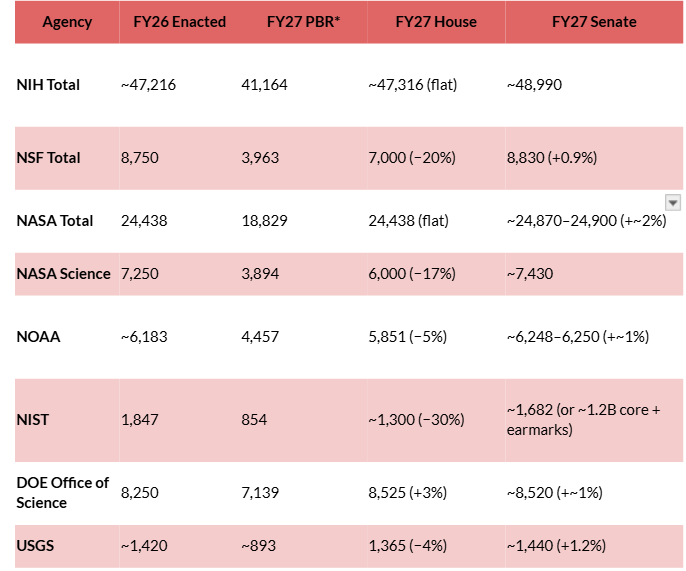
*President’s Budget Request
Sources: AAAS FY27 R&D Budget Analysis; Senate Appropriations Committee FY27 bill texts and explanatory statements (CJS, LHHS, FSGG, and related bills).
NSF funding outlook: Golden Age of Science on a budget
The President’s FY27 Budget Request from April 2026 sought to significantly shrink the NSF budget to roughly $3.96 billion in discretionary funding—an unprecedented cut of 55 percent from the $8.75 billion enacted for FY26—with plans to concentrate resources on AI, quantum, the Genesis Mission, and proposing the elimination of the Social, Behavioral, and Economic Sciences directorate (SBE). Both the House and Senate appropriation bills have rejected the deep cuts with the House Appropriations Committee landing the agency at $7 billion (a 20 percent reduction), whereas the Senate’s Commerce-Justice-Science bill released in mid-November holds NSF near $8.83 billion, close to FY26 enacted levels. While many policy analyses have noted the lack of explicit protective language against OMB’s proposed rule, the Senate’s draft does contain some useful guardrails that are worth paying attention to. Negotiations and advocacy must continue to secure more robust oversight and accountability language across the final bills. On NSF specifically, several differences between the House and Senate versions stand out:
The House language is relatively sparse on structural protections and leaves more discretion to the agency (silent on the proposed elimination of SBE and accepts the consolidation of STEM Education under Research and Related Activities).
The Senate language is more assertive. Senate report language explicitly rejects the SBE elimination, directs continued use of FY2024 negotiated indirect-cost rates, flags administration noncompliance with prior limits on directorate-level cuts, and imposes requirements on the timely release of funding opportunities. The Senate draft also includes the following provisions:
National Science Board: Keeps funding flat at $5 million. Expresses alarm at the dismissal of the entire Board, emphasizes its independent oversight role, and calls for prompt appointment of qualified new members.
Graduate Research Fellowship Program: Calls for at least 2,000 new fellowships and eligibility for students at the start of their second year. Criticizes recent NSF changes made without a “reasonable transition period.”
Oversight-specific language:
30-day advance notification to the Appropriations Committees before any planned divestment, transfer, decommissioning, or deconstruction of NSF-owned facilities or capital assets valued over $2.5 million.
Notices of funding opportunities must be publicly posted no later than 90 days after enactment (waiver requires a signed justification letter to the Committees).
Standard quarterly reports on balances of appropriations and spending plans within 45 days of enactment.
Transfer limits between NSF accounts with notification/reprogramming rules.
Overall, the Senate draft contains stronger oversight language and is the clearer vehicle for the kinds of guardrails science advocacy organizations have sought. While it is encouraging to see the Committee respond to those concerns, the language remains limited. More can still be done to constrain agencies and political appointees from delaying disbursements, redirecting funds, or terminating awards on grounds that conflict with congressional intent.
Science advocacy organizations should urge Congress not only to block or repeal the proposed OMB indirect-cost rule, but also to adopt clearer limits on withholding, reprogramming, and politically driven terminations in the final bills.
Science advocates should pursue a two-track approach in the remaining negotiation efforts:
In the Financial Services and General Government bill (the vehicle that funds OMB), press for language that directly blocks or nullifies the proposed rule on federal financial assistance, rather than relying solely on the existing FY2024 rate protection.
In the Commerce, Justice, and Science and Labor, Health, and Human Services bills, focus on strengthening agency-level accountability and oversight provisions. This should include tighter limits on political appointees’ ability to delay disbursements, impose new conditions, reprogram funds, or terminate awards in ways that conflict with congressional intent—backed by clearer notification, justification, and reporting requirements.
The current Senate drafts already point in this direction (FY2024 rate language in FSGG/CJS/LHHS plus various reporting requirements), but they stop short of either fully blocking the rule or imposing strong constraints on political leadership.